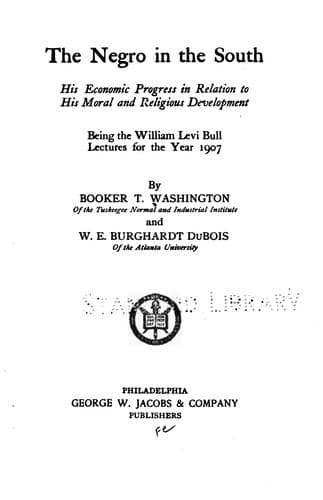
The Negro in the South: His Economic Progress in Relation to his Moral and Religious DevelopmentDu Bois, W. E. B. (William Edward Burghardt)
History
The Negro in the South: His Economic Progress in Relation to his Moral and Religious Development
Du Bois, W. E. B. (William Edward Burghardt)
African Americans -- Southern States
Given these premises the economic answer of the South was, from a
business standpoint, perfectly sound. The men who, starting poor after
a miserable war, went into the development of the South, went in to
make money--to use the great American thesis, they were "not in
business for their health." They were going to grant to the laborer
just as little as they must; the laborer was unused to a system of
free labor, he was not a steady workman, he was not a skilled workman,
he had been for two or three hundred years driven to his work, he took
no pride in his work--how could he take pride in that which hitherto
had been the badge of his shame?
Now it was not considered the business of the new Southern business
man to develop and train the working man. It was his business, as I
have said, from the American point of view, to make money. And the
consequence was that he evolved a peculiarly ingenious system of land
serfdom, which bears many likenesses to the serfdom that replaced
slavery in Europe. The land belonged to the landlord--it was rented
out to the serf; the serf was nominally free, but as a matter of fact
he was not free at all; he was held to his labor: he rose with the
morning work bell of slavery days, he was driven to his labor by
mounted riders, he was whipped for delinquencies, he received no
stipulated return, but on the contrary the owner of the land made the
contract, kept the accounts, and gave him enough once or twice a year
to make him not too dissatisfied.
After a time this changed somewhat; instead of the land owner himself
undertaking the advancing of supplies, a third party, the merchant
with capital, came in. In order to enforce such a system it needed to
be backed by a peculiar law system--therefore the business men went
into politics in the South with the same result as when business men
go into politics in the North. Things were done quickly and quietly;
they were done not for the good of people who had no political voice,
but for the good of those who wielded the political power, _i.e._, the
business men and land owners. The laws were made to favor the landlord
and the merchant and to make it easy to exploit the tenant and
laborer.
Public-domain text, read in full here on John Shaqi.
Reviews
Reviews
No reviews yet
Be the first to share your thoughts on this work.
Join the Discussion
Join the discussion
Sign in to leave a comment or review.
Sign InorCreate an account