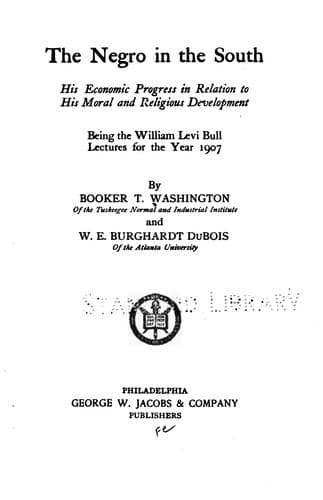
The Negro in the South: His Economic Progress in Relation to his Moral and Religious Development — John Shaqi
The Negro in the South: His Economic Progress in Relation to his Moral and Religious DevelopmentDu Bois, W. E. B. (William Edward Burghardt)
History
The Negro in the South: His Economic Progress in Relation to his Moral and Religious Development
Du Bois, W. E. B. (William Edward Burghardt)
African Americans -- Southern States
This system, which still is the rule of agricultural labor in the
black belt of the South, is not a system of free labor; it is simply
a form of peonage. The black peon is held down by perpetual debt or
petty criminal judgments; his rent rises with the price of cotton, his
chances to buy land are either non-existent or confined to infertile
regions. Judge and jury are in honor bound to hold him down; if by
accident or miracle he escapes and becomes a landholder, his property,
civil and political status are still at the mercy of the worst of the
white voters, and his very life at the whim of the mob. The power of
the individual white patron to protect colored men is still great and
is often exercised, but this is but another argument against the
system: it is undemocratic and un-American, and stamps on the serf
system its most damning criticism.
Moreover, this second attempt to meet the economic revolution of the
South is failing, and its failure is shown by the scarcity of farm
labor, the migration of Negroes, and the increase of crime and
lawlessness. Serfdom like slavery demands ignorance and strict laws.
The decade of Negro voting and Northern benevolence had however given
the Negro schools and aspiration.
What now has been the reaction of this group on the environment thrown
around it since slavery days?
The slaves had their select classes in the house servants and the
artisans. After freedom came, the Negro made four distinct efforts to
reach economic safety. The first effort was by means of the select
house-servant class; the second, by means of competitive industry; the
third, by land-owning; and the fourth, by what I shall call the group
economy.
First, let us look at the effort of the house servants. The one person
under the slave régime who came nearest to escaping from the toils of
slavery and the disabilities of caste was the favorite house servant.
This was because the house servant was brought into contact with the
culture of the master and the family, because he had often the
advantages of town and city life, was able to gain some smattering of
education, and also because he was usually a blood relative of the
master class. These house servants, therefore, became the natural
leaders of the emancipated race and the brunt of the burden of
reconstruction fell upon their shoulders. When the history of this
period is carefully written it will show that few men ever made a more
meritorious fight against overwhelming odds.
Public-domain text, read in full here on John Shaqi.
Reviews
Reviews
No reviews yet
Be the first to share your thoughts on this work.
Join the Discussion
Join the discussion
Sign in to leave a comment or review.
Sign InorCreate an account