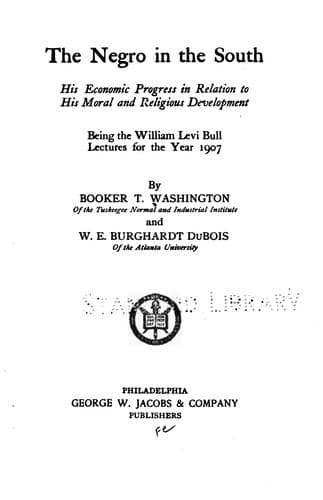
The Negro in the South: His Economic Progress in Relation to his Moral and Religious DevelopmentDu Bois, W. E. B. (William Edward Burghardt)
History
The Negro in the South: His Economic Progress in Relation to his Moral and Religious Development
Du Bois, W. E. B. (William Edward Burghardt)
African Americans -- Southern States
Under free competition it would have been natural for this class of
house servants to enter the economic life of the nation directly. In
some cases this happened, especially in the case of the barber and the
caterer. For the most part, however, the black applicant was refused
admittance to the economic society of the nation. He held his own in
the semi-servile work of barber until he met the charge of color
discrimination in his own race, and the competition of foreigners. The
caterer was displaced by palatial hotels in which he could have no
part.
On the whole, then, the mass of house servants soon found the doors in
their own lines closed in their faces. They could remain good servants
but they could not by this means often escape into higher walks of
life. The better tenth of them went gradually into professions and
thus found economic independence for themselves and their children.
The mass of them either remained house servants or turned toward
industry.
The second attempt of the freedmen toward economic safety lay in
industry. It was a less ambitious effort than that of the house
servants, and included larger numbers of men. It was characterized by
a large migration to the towns. Here it was that the class of slave
artisans made themselves felt in freedom and they were joined by
numbers of unskilled workmen, such as steam railway hands, porters,
hostlers, etc. This class attracted considerable attention and bore
the brunt of the economic battle in competition with white working
men. It is a class that is growing and in the future it is going to
have a large development. At present, however, its fight is difficult.
The third effort of economic elevation was by land owning. This was
the ideal toward which the great mass of black people looked. They at
first thought that the government was going to help them, and the
government did in a few instances, as when Sherman distributed land in
Georgia and the government sold South Carolina lands for taxes. For
the most part, however, the Negroes had to buy their own lands which
they did in some cases by means of their bounty money for serving in
the army or by means of special monies which they earned as workmen
during the war or by the help of the former masters. Some too, by the
share tenant system gained enough to buy land. In this way about
200,000 to-day own their farms and thus approximate economic
independence.
Public-domain text, read in full here on John Shaqi.
Reviews
Reviews
No reviews yet
Be the first to share your thoughts on this work.
Join the Discussion
Join the discussion
Sign in to leave a comment or review.
Sign InorCreate an account