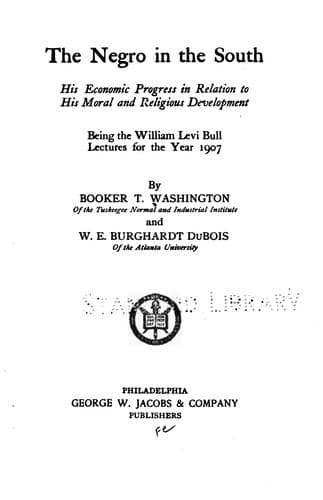
The Negro in the South: His Economic Progress in Relation to his Moral and Religious DevelopmentDu Bois, W. E. B. (William Edward Burghardt)
History
The Negro in the South: His Economic Progress in Relation to his Moral and Religious Development
Du Bois, W. E. B. (William Edward Burghardt)
African Americans -- Southern States
The fourth and last effort, which I call the Group Economy, is of
great importance, but is not very well understood. It consists of a
coöperative arrangement of industry and service in a group which tends
to make the group a closed economic circle, largely independent of
surrounding whites. This development explains many anomalies in the
situation of the Negro. Many people think that the colored barber is
disappearing, yet there are more colored barbers in the United States
to-day than ever before, but a larger number than ever cater to only
colored trade. The Negro lawyer serves almost exclusively colored
clientage, so that his existence is half forgotten by the white world.
The new Negro business men are not successors of the old. There used
to be Negro business men in Northern cities and a few even in Southern
cities, but they catered to white trade; the Negro business man to-day
caters to colored trade. So far has this gone to-day that in every
city in the United States which has considerable Negro population, the
colored group is serving itself in religion, medical care, legal
advice and often educating its children. In growing degree also it is
serving itself in insurance, houses, books, amusements.
So extraordinary has been this development that it forms a large and
growing part in the economy of perhaps half the Negroes of the United
States, and in the case of perhaps 100,000 town Negroes, representing
at least 300,000 persons, the group economy approaches a complete
system. To these we may add the bulk of 200,000 farmers who own their
farms. Thus we have a group of half a million who are reaching
economic safety by means of group economy (see Note 9).
Here then are the two developments--a determined effort at an
established serfdom on the part of landholding capitalists, and a
determined effort on the part of freedmen and their sons to attain
economic independence.
While both these movements were progressing the full change of the
industrial revolution, so long postponed, began to be felt all over
the South; the iron and steel industry developed in Alabama and
Tennessee, coal mining in Tennessee and West Virginia, and cotton
manufacture in Carolina and Georgia; railways were consolidated into
systems and extended, commerce was organized and concentrated. The
greatest single visible result of this was the growth of cities. Towns
of eight thousand and more had a tenth of the white Southerners in
1860; they held a seventh of a much larger population in 1900, while
a fifth were in cities and villages. Still more striking was the
movement of Negroes; only four per cent. were in cities before the
war, to-day a seventh are there.
Public-domain text, read in full here on John Shaqi.
Reviews
Reviews
No reviews yet
Be the first to share your thoughts on this work.
Join the Discussion
Join the discussion
Sign in to leave a comment or review.
Sign InorCreate an account