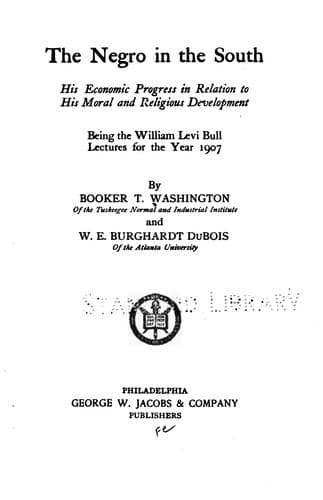
The Negro in the South: His Economic Progress in Relation to his Moral and Religious DevelopmentDu Bois, W. E. B. (William Edward Burghardt)
History
The Negro in the South: His Economic Progress in Relation to his Moral and Religious Development
Du Bois, W. E. B. (William Edward Burghardt)
African Americans -- Southern States
The reason for this is clear: the oppression and serfdom of the
country, the opportunities of the city. It was in the town and city
alone that the emerging classes, outside the landholders, were
successful, and even the landholders were helped by the earnings of
the city; the house servants with the upper class of barbers and
caterers, the artisans, the day laborers, the professional men,
including the best of the teachers, were in the cities, and the new
group economy was developed here.
On the other hand one of the inevitable expedients for fastening
serfdom on the country Negro was enforced ignorance.
The Negro school system established by the Negro reconstruction
governments reached its culmination in the decade 1870-1880. Since
then determined effort has been made in the country districts to make
the Negro schools less efficient. To-day these schools are worse than
they were twenty years ago; the nominal term is longer and the
enrolment larger, but the salaries are so small that only the poorest
local talent can teach. There is little supervision, there are few
appliances, few schoolhouses and no inspiration. On the other hand the
city schools have usually improved. It was natural that the Negro
should rush city-ward toward freedom, education, and decent wages.
This migration resulted in two things: in the increase and
intensification of the problems of the city, and in redoubled effort
to keep the Negro laborer on the plantations.
To take the latter efforts first, we find that the efforts of the
landlords to keep Negro labor varied from force to persuasion: force
was used by the landlords to the extent of actual peonage, by which
Negroes were held on plantations in large numbers; next to peonage for
crime came debt peonage, which used the indebtedness of the Negro
tenants to prevent their moving away; then came the system of labor
contracts and the laws making the breaking of a labor contract a crime
(see Note 10); after that came a crop of vagrancy laws aimed at the
idle Negroes in city and town and designed to compel them to work on
farms, going so far in several states as to reverse the common law
principle and force the person arrested for vagrancy to prove his
innocence (see Note 11).
In order that the farm laborers should not be tempted away by higher
wages, penalties were laid on "enticing laborers away" and agents were
compelled to take out licenses which ran as high as $2,000 for each
county in some states (see Note 12). Such laws and their
administration required, of course, absolute control of the
government and courts. This was secured by manipulation and fraud,
while at the same time the landlords of the black belt usually opposed
the disfranchisement of Negroes lest such a measure reduce their
political influence which was based on the Negro population.
Public-domain text, read in full here on John Shaqi.
Reviews
Reviews
No reviews yet
Be the first to share your thoughts on this work.
Join the Discussion
Join the discussion
Sign in to leave a comment or review.
Sign InorCreate an account