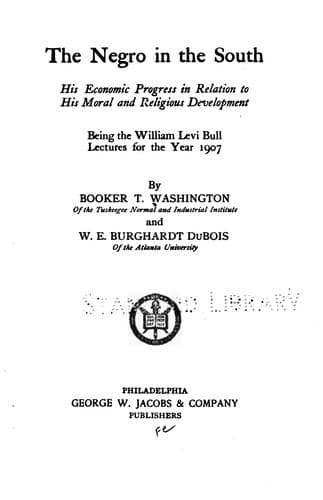
The Negro in the South: His Economic Progress in Relation to his Moral and Religious DevelopmentDu Bois, W. E. B. (William Edward Burghardt)
History
The Negro in the South: His Economic Progress in Relation to his Moral and Religious Development
Du Bois, W. E. B. (William Edward Burghardt)
African Americans -- Southern States
All these measures were measures of force, while nothing was done to
attract laborers to the land. The only real attraction of the Negro to
the country was landowning. The Negroes had succeeded in buying land:
by government gift and bounty money they held about three million
acres in 1875, perhaps 8,000,000 in 1890, and 12,000,000 in 1900; but
distinct efforts appeared here and there to stop their buying land.
There are still vast tracts of land in the South, that anybody, black
or white, can buy for little or nothing, simply because it is worth
little or nothing. Some time, of course, these lands will become
valuable but they are not valuable to-day. Now the Negro cannot invest
in this land as a speculation, for he is too poor to wait. He must
have land which he knows how to cultivate, which is near a market, and
which is so situated as to provide reasonable protection for his
family. There are only certain crops which he knows how to cultivate.
He cannot be expected to learn quickly to cultivate crops which he was
not taught to cultivate in the past. He must be within reach of a
market and he must have some community life with his own people and
some protection from other people.
All these conditions are fulfilled chiefly in the black belt. That is
the cotton region, the crop which he knows best how to raise; from
certain parts of it he can get to the market and he has a great black
population for company and protection. But it is precisely here in the
black belt that it is most difficult to buy land. Capitalistic culture
of cotton, the high price of cotton, and the system of labor peonage
have made land high. Moreover in most of these regions it is
considered bad policy to sell Negroes land because, as has been said,
this "demoralizes" labor. Thus in the densest part of the black belt
in the South, the percentage of land holding is usually low among
Negroes.
The concentration of land-owning on the other hand in the hands of the
single white proprietors has gone on to a much larger extent than the
country realizes. This is shown not simply in the increase of the
average size of farms in the last decade but it must also be
remembered that the farms do not belong to single owners but are owned
in groups of five, forty or fifty by single landed proprietors. There
are 140,000 owners who own from two to fifty farms in the South and
there are 50,000 owners who have over twenty farms apiece.
Public-domain text, read in full here on John Shaqi.
Reviews
Reviews
No reviews yet
Be the first to share your thoughts on this work.
Join the Discussion
Join the discussion
Sign in to leave a comment or review.
Sign InorCreate an account