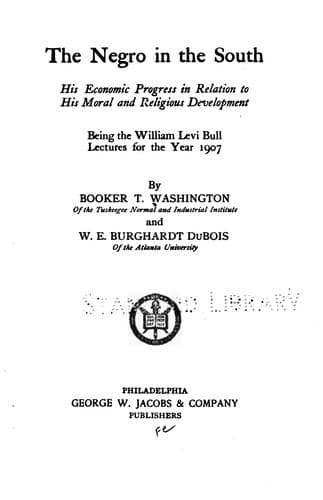
The Negro in the South: His Economic Progress in Relation to his Moral and Religious DevelopmentDu Bois, W. E. B. (William Edward Burghardt)
History
The Negro in the South: His Economic Progress in Relation to his Moral and Religious Development
Du Bois, W. E. B. (William Edward Burghardt)
African Americans -- Southern States
It is not true then to-day that land-buying for the average colored
farmer in the South is an easy thing. The land which has been bought
has been bought by the exceptional men or by the men who have had
unusual opportunity, who have been helped by their former masters or
by some other patrons, who have been aided by members of their own
families in the North or in the cities, or who have escaped the
wretched crop system by some sudden rise in the price of cotton, which
did not enable the landlord to take the whole economic advantage. It
is therefore in spite of the land system and not because of it that
the Negroes to-day own 12,000,000 acres of land (see Note 13).
The net result of the whole policy of serfdom was so to deplete the
ranks of laborers that a new solution of the labor problem must be
found.
Here it was that the southern city came forward. The city had new
significance, especially new cities like Atlanta, Birmingham, and
Chattanooga as contrasted with Charleston and Savannah. They saw a
new industrial solution of the problem of Negro labor. It was a simple
program: Industry and disfranchisement; the separation of the masses
of the Negroes from all participation in government, and such
technical training as should fit them to become skilled working men.
There was an _arriere pensee_ here too, born in the minds of northern
capitalists. The white southern working men were becoming unionized by
northern agitators; here was a chance to keep them down to reasonable
demands by black competition and the threat of more competition in the
future. Moreover working men without votes would be far more docile
and tractable. Politics had already spoiled the Negroes. Let the
whites rule and the blacks work.
The plea was specious, it had the sanction of great names, of wealth
and social influence, and it convinced not only those who wanted to be
convinced but practically all Americans who were eager to be relieved
of troublesome questions and difficult public duties.
All the more eagerly was this solution seized upon because of the
definite and distinct promises which it made. Disfranchise the Negro,
said the South, and the race problem is solved; there is no race
problem save the menace of an ignorant and venal vote;--relieve us
from this and the lion and the lamb will lie down together;--the Negro
will go peacefully and contentedly to work and the whites will wax
just and rich. We all remember with what confidence and absolute
certainty of conviction this program was announced when Mississippi
disfranchised her Negro voters seventeen years ago. It was repeated
twelve years ago in South Carolina, ten years ago in Louisiana, and
still more recently in North Carolina and Alabama.
Public-domain text, read in full here on John Shaqi.
Reviews
Reviews
No reviews yet
Be the first to share your thoughts on this work.
Join the Discussion
Join the discussion
Sign in to leave a comment or review.
Sign InorCreate an account