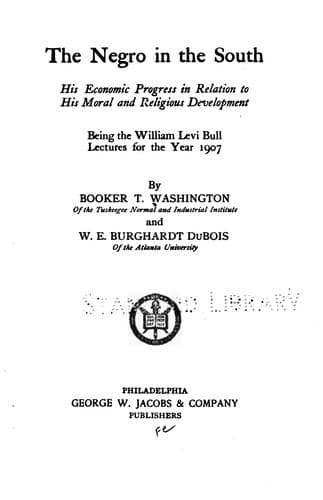
The Negro in the South: His Economic Progress in Relation to his Moral and Religious DevelopmentDu Bois, W. E. B. (William Edward Burghardt)
History
The Negro in the South: His Economic Progress in Relation to his Moral and Religious Development
Du Bois, W. E. B. (William Edward Burghardt)
African Americans -- Southern States
What has been the result? Is the race problem solved? Is the Negro out
of politics in the South? Has there been a single southern campaign
in the last twenty years in which the Negro has not figured as the
prime issue? Have the southern representatives in Congress any settled
convictions or policy save hatred of black men, and can they discuss
any other matter? Is it not the irony of fate that in the state that
first discovered the legal fraud of disfranchisement a hot political
battle is to-day waging on the old, old question: the right of black
men to vote?
The reason for all this is not far to seek. In modern industrial
democracy disfranchisement is impossible. The fate, wishes, and
destiny of ten million human beings cannot be delivered, sealed and
bound into the keeping of Dixon, Tillman, Vardaman, and Nelson Page.
They are bound to vote even when disfranchised.
Disfranchised and voiceless though I am in Georgia to-day by the
illegal White Primary system, there are still fifty congressmen in
Washington fraudulently representing me and my fellows in the
councils of the nation (see Note 14).
It was promised that disfranchisement would lead to more careful
attention to the Negro's moral and economic advancement. It has on the
contrary stripped them naked to their enemies; discriminating laws of
all sorts have followed, the administration of other laws has become
harsher and more unfair, school funds have been curtailed and
education discouraged, and mobs and murder have gone on.
If the new policy has been a farce politically and socially, how much
more has it failed as an economic cure-all! No sooner was it
proclaimed from the house-tops than the rift in the lute appeared. "We
do not want educated farmers," cried the landlords, "we want docile
laborers." "We do not want educated Negro artisans," cried the white
artisans, and they enforced their demands by their votes and by mob
violence. "We do not want to raise the Negro; we want to put him in
his place and keep him there," cried the dominant forces of the South.
Then those northerners who had lightly embraced the fair sounding
program of limited labor training and disfranchisement found
themselves grasping the air.
Not only this, but the South itself faced a puzzling paradox. The
industrial revolution was demanding labor; it was demanding
intelligent labor, while the supposed political and social exigences
of the situation called for ignorance and subserviency. It was an
impossible contradiction and the South to-day knows it.
Public-domain text, read in full here on John Shaqi.
Reviews
Reviews
No reviews yet
Be the first to share your thoughts on this work.
Join the Discussion
Join the discussion
Sign in to leave a comment or review.
Sign InorCreate an account