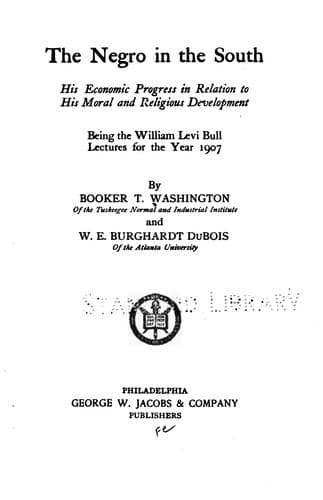
The Negro in the South: His Economic Progress in Relation to his Moral and Religious DevelopmentDu Bois, W. E. B. (William Edward Burghardt)
History
The Negro in the South: His Economic Progress in Relation to his Moral and Religious Development
Du Bois, W. E. B. (William Edward Burghardt)
African Americans -- Southern States
What is it that makes a successful laboring force? It is laborers of
education and natural intelligence, reasonably satisfied with their
conditions, inspired with certain ideals of life, and with a growing
sense of self-respect and self-reliance. How is the caste system of
the South influencing the Negro laborer? It is systematically
restricting his development; it is restricting his education so that
the public common schools of the South except in a few cities are
worse this moment than they were twenty years ago; it is seeking to
kill self-respect by putting upon the accident of color every mark of
humiliation that it can invent; it is discouraging self-reliance by
treating a class of men as wards and children; it is killing ambition
by drawing a color line instead of a line of desert and
accomplishment; and finally, through these things, it is encouraging
crime, and by the unintelligent and brutal treatment of criminals, it
is developing more crime.
This general attitude toward the main laboring class reflects itself
less glaringly but as certainly in the treatment even of white
laborers. So long as white labor must compete with black labor, it
must approximate black labor conditions--long hours, small wages,
child labor, labor of women, and even peonage. Moreover it can raise
itself above black labor only by a legalized caste system which will
cut off competition and this is what the South is straining every
nerve to create.
The last fatal campaign in Georgia which culminated in the Atlanta
Massacre was an attempt, fathered by conscienceless politicians, to
arouse the prejudices of the rank and file of white laborers and
farmers against the growing competition of black men, so that black
men by law could be forced back to subserviency and serfdom. It
succeeded so well that smouldering hate burst into flaming murder
before the politicians could curb it.
There is, however, a limit to this sort of thing. The day when mobs
can successfully cow the Negro to willing slavery is past. The Atlanta
Negroes shot back and shot to kill, and that stopped the riot with a
certain suddenness (see Note 15). The South is realizing that
lawlessness and economic advance cannot coexist. If the wonderful
industrial revolution is to develop unhindered, the South must have
law and order and it must have intelligent workmen.
It is only a question of time when white working men and black working
men will see their common cause against the aggressions of exploiting
capitalists. Already there are signs of this: white and black miners
are working as a unit in Alabama; white and black masons are in one
union in Atlanta (see Note 16). The economic strength of the Negro
cannot be beaten into weakness, and therefore it must be taken into
partnership, and this the Southern white working man, befuddled by
prejudice as he is, begins dimly to realize.
Public-domain text, read in full here on John Shaqi.
Reviews
Reviews
No reviews yet
Be the first to share your thoughts on this work.
Join the Discussion
Join the discussion
Sign in to leave a comment or review.
Sign InorCreate an account