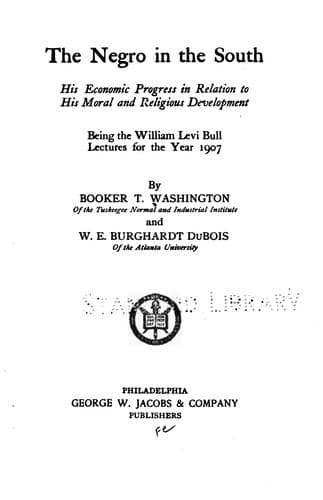
The Negro in the South: His Economic Progress in Relation to his Moral and Religious DevelopmentDu Bois, W. E. B. (William Edward Burghardt)
History
The Negro in the South: His Economic Progress in Relation to his Moral and Religious Development
Du Bois, W. E. B. (William Edward Burghardt)
African Americans -- Southern States
The Indian and the Negro met on the American continent for the first
time at Jamestown, in 1619. Both were in the darkest barbarism. There
were twenty Negroes and thousands of Indians. At the present time
there are between nine and ten million Negroes and two hundred and
eighty-four thousand and seventy-nine Indians. The annual tax upon the
Government on account of the Indian is $14,236,078.71 (1905); the cost
from 1789 to 1902, inclusive, reached the sum of $389,282,361.00. The
one in this case not only decreased in numbers and failed to add
anything to the economic value of his country, but has actually proven
a charge upon the state.
The Negro seems to be about the only race that has been able to look
the white man in the face during the long period of years and
live--not only live, but multiply. The Negro has not only done this,
but he has had the good sense to get something from the white man at
every point where he has touched him--something that has made him a
stronger and a better race.
Let me say in the beginning that nothing which I shall say should be
taken as an endorsement of the enslavement of my race. The experience
of the world's civilization teaches that the final and net result of
slavery is bad--bad for the enslaved, and perhaps worse for the
enslaver. If permitted a choice, I think I should prefer being the
first to being the last. But in the case of the Negro in America no
one, willing to be frank and fair, can fail to see that the Negro did
get certain benefits out of slavery; at the same time he was, as I
have stated, harmed. But in this connection we must deal with the
facts and not with prejudice, either for or against the race.
Let me make this statement with which you may or may not agree: In my
opinion, there cannot be found in the civilized or uncivilized world
ten millions of Negroes whose economic, educational, moral and
religious life is so advanced as that of the ten millions of Negroes
within the United States. If this statement be true, let us find the
cause thereof, especially as regards the Negro's moral and Christian
growth. In doing so, let credit be given wherever it is due, whether
to the Northern white man, the Southern white man, or the Negro
himself. If, as stated, the ten millions of black people in the United
States have excelled all the other groups of their race-type in moral
and Christian growth, let us trace the cause, and in doing so we may
get some light and information that will be of value in dealing with
the Negro race in America and elsewhere, and in elevating and
Christianizing other races.
In order to determine the influence of economic or industrial training
upon the moral and Christian life of the Negro, we must begin with
slavery and trace the development of the black man, noticing in a
brief manner his development through slavery to freedom, and to the
present time.
Public-domain text, read in full here on John Shaqi.
Reviews
Reviews
No reviews yet
Be the first to share your thoughts on this work.
Join the Discussion
Join the discussion
Sign in to leave a comment or review.
Sign InorCreate an account