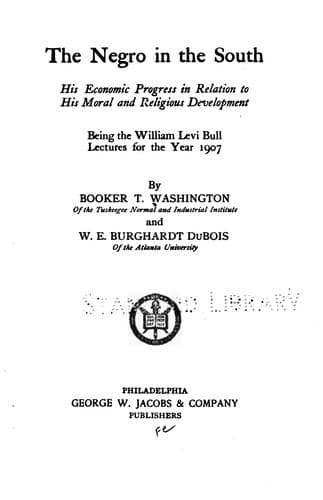
The Negro in the South: His Economic Progress in Relation to his Moral and Religious DevelopmentDu Bois, W. E. B. (William Edward Burghardt)
History
The Negro in the South: His Economic Progress in Relation to his Moral and Religious Development
Du Bois, W. E. B. (William Edward Burghardt)
African Americans -- Southern States
The church recognized the situation and the Episcopal church
especially gave itself easily to this new conception. This church
recognized the social gradation of men; all souls were equal in the
sight of God, but there were differences in worldly consideration and
respect, and consequently it was perfectly natural that there should
be an aristocracy at the top and a group of serfs at the bottom.
Meantime, however, America began to be stirred by a new democratic
ideal; there came the reign of that ruler of men, Andrew Jackson;
there came the spread of the democratic churches, Methodist and
Baptist, and the democratization of other churches. Now when America
became to be looked upon more and more as the dwelling place of free
and equal men and when the Methodist and, particularly, the Baptist
churches went down into the fields and proselyted among the slaves, a
thing which the more aristocratic Episcopal church had never done (see
Note 21), there came new questions and new heart-searchings among
those who wanted to explain the difficulties and to think and speak
clearly in the midst of their religious convictions.
As such people began to look round them the condition of the slaves
appalled them. The Presbyterian Synod of South Carolina and Georgia
declared in 1833: "There are over two millions of human beings in the
condition of heathen and some of them in a worse condition. They may
be justly considered the heathen of this country, and will bear a
comparison with heathen in any country in the world. The Negroes are
destitute of the gospel, and ever will be under the present state of
things. In the vast field extending from an entire state beyond the
Potomac [_i.e._, Maryland] to the Sabine River [at the time our
southwestern boundary] and from the Atlantic to the Ohio, there are,
to the best of our knowledge, not twelve men exclusively devoted to
the religious instruction of the Negroes. In the present state of
feeling in the South, a ministry of their own color could neither be
obtained nor tolerated.
"But do not the Negroes have access to the gospel through the stated
ministry of the whites? We answer, no. The Negroes have no regular and
efficient ministry; as a matter of course, no churches; neither is
there sufficient room in the white churches for their accommodation.
We know of but five churches in the slave-holding states built
expressly for their use. These are all in the state of Georgia. We may
now inquire whether they enjoy the privileges of the gospel in their
own houses, and on our plantations? Again we return a negative answer.
They have no Bibles to read by their own firesides. They have no
family altars; and when in affliction, sickness, or death, they have
no minister to address to them the consolations of the gospel, nor to
bury them with appropriate services."
Public-domain text, read in full here on John Shaqi.
Reviews
Reviews
No reviews yet
Be the first to share your thoughts on this work.
Join the Discussion
Join the discussion
Sign in to leave a comment or review.
Sign InorCreate an account