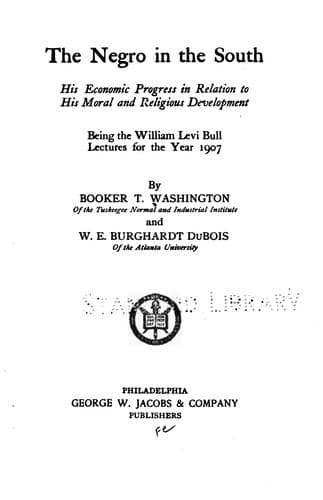
The Negro in the South: His Economic Progress in Relation to his Moral and Religious DevelopmentDu Bois, W. E. B. (William Edward Burghardt)
History
The Negro in the South: His Economic Progress in Relation to his Moral and Religious Development
Du Bois, W. E. B. (William Edward Burghardt)
African Americans -- Southern States
The same synod said in 1834: "The gospel, as things now are, can never
be preached to the two classes (whites and blacks) successfully in
conjunction. The galleries or back seats on the lower floor of white
churches are generally appropriated to the Negroes, when it can be
done without inconvenience to the whites. When it cannot be done
conveniently, the Negroes must catch the gospel as it escapes through
the doors and windows. If the master is pious, the house servants
alone attend family worship, and frequently few of them, while the
field hands have no attention at all. So far as masters are engaged in
the work [of religious instruction of slaves], an almost unbroken
silence reigns on this vast field."
The Rev. C.C. Jones, a Georgian and ardent defender of slavery (see
Note 22) says of the period 1790-1820: "It is not too much to say that
the religious and physical condition of the Negroes were both improved
during this period. Their increase was natural and regular, ranging
every ten years between thirty-four and thirty-six per cent. As the
old stock from Africa died out of the country, the grosser customs,
ignorance, and paganism of Africa died with them. Their descendants,
the country-born, were better looking, more intelligent, more
civilized, more susceptible of religious impressions.
"On the whole, however, but a minority of the Negroes, and that a
small one, attended regularly the house of God, and taking them as a
class, their religious instruction was extensively and most seriously
neglected."
And of the decade 1830-40, he insists: "We cannot cry out against the
Papists for withholding the Scriptures from the common people and
keeping them in ignorance of the way of life, for we withhold the
Bible from our servants, and keep them in ignorance of it, while we
will not use the means to have it read and explained to them."
Such condition stirred the more radical-minded toward abolition
sentiments and the more conservative toward renewed effort to
evangelize and better the condition of the slaves. This condition was
deplorable as Jones pictures it. "Persons live and die in the midst of
Negroes and know comparatively little of their real character. They
have not the immediate management of them. They have to do with them
in the ordinary discharge of their duty as servants, further than this
they institute no inquiries; they give themselves no trouble.
Public-domain text, read in full here on John Shaqi.
Reviews
Reviews
No reviews yet
Be the first to share your thoughts on this work.
Join the Discussion
Join the discussion
Sign in to leave a comment or review.
Sign InorCreate an account