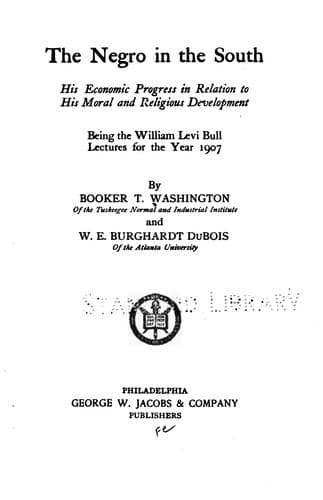
The Negro in the South: His Economic Progress in Relation to his Moral and Religious Development — John Shaqi
The Negro in the South: His Economic Progress in Relation to his Moral and Religious DevelopmentDu Bois, W. E. B. (William Edward Burghardt)
History
The Negro in the South: His Economic Progress in Relation to his Moral and Religious Development
Du Bois, W. E. B. (William Edward Burghardt)
African Americans -- Southern States
This involves, then, the period of slavery, and the period of
freedom. To begin with, let me repeat that at first, at least, the
underlying object of slavery was an economic, and an industrial one.
The climatic and other new conditions required that the slave should
wear clothing, a thing, for the most part, new to him. It has perhaps
already occurred to you that one of the conditions requisite for the
Christian life is clothing. So far as I know, Christianity is the only
religion that makes the wearing of clothes one of its conditions. A
naked Christian is impossible--and I may add that I have little faith
in a hungry Christian.
Some years ago we were holding the Tuskeegee Annual Negro Conference,
and I remember on several occasions there was one old fellow who tried
to get the floor without success. He tried continually to get
recognition from the chair, and, finally, was recognized. He said:
"Mr. Washington, we's making great progress in our community. It is
not the same as it used to be. We's making great progress. We's
getting to the point where nearly all the people in my community owns
their own pigs." I asked him why he was so much interested in his
neighbors owning their own pigs. He said: "I feel that when all my
neighbors own their own pigs, I can always sleep better every night."
There is a good deal of philosophy underlying that remark.
The economic element not only made it necessary that the Negro slave
should be clothed for the sake of decency and in order to preserve his
health, but the same considerations made it necessary that he be
housed and taught the comforts to be found in a home. Within a few
months, then, after the arrival of the Negro in America, he was
wearing clothes and living in a house--no inconsiderable step in the
direction of morality and Christianity. True, the Negro slave had worn
some kind of garment and occupied some kind of hut before he was
brought to America, but he had made little progress in the improvement
of his garments or in the kind of hut he inhabited. As we shall
perhaps see later, his introduction into American slavery was the
beginning of real growth in the two directions under consideration.
There is another important element. In his native country, owing to
climatic conditions, and also because of his few simple and crude
wants, the Negro, before coming to America, had little necessity to
labor. You have, perhaps, read the story, that it is said might be
true in certain portions of Africa, of how the native simply lies down
on his back under a banana-tree and falls asleep with his mouth open.
The banana falls into his mouth while he is asleep and when he wakes
up he finds that all he has to do is to chew it--he has his meal
already served.
Public-domain text, read in full here on John Shaqi.
Reviews
Reviews
No reviews yet
Be the first to share your thoughts on this work.
Join the Discussion
Join the discussion
Sign in to leave a comment or review.
Sign InorCreate an account