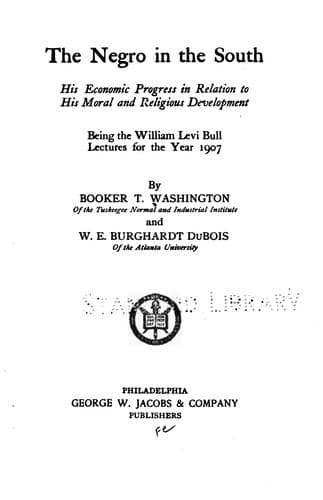
The Negro in the South: His Economic Progress in Relation to his Moral and Religious Development — John Shaqi
The Negro in the South: His Economic Progress in Relation to his Moral and Religious DevelopmentDu Bois, W. E. B. (William Edward Burghardt)
History
The Negro in the South: His Economic Progress in Relation to his Moral and Religious Development
Du Bois, W. E. B. (William Edward Burghardt)
African Americans -- Southern States
Notwithstanding the fact that, in most cases, the element of
compulsion entered into the labor of the slave, and the main object
sought was the enrichment of the owner, the American Negro had, under
the regime of slavery, his first lesson in anything like continuous,
progressive, systematic labor. I have said that two of the signs of
Christianity are clothes and houses, and now I add a third, "work."
In the early days of slavery the labor performed by the slave was
naturally of a crude and primitive kind. With the growth of
civilization came a demand for a higher kind of labor, hence the Negro
slave was soon demanded as a skilled laborer, as well as for ordinary
farm and common labor. It soon became evident that from an economic
point of view it paid to give the Negro just as high a degree of skill
as possible--the more skill, the more dollars. When an ordinary slave
sold for, say seven hundred dollars, a skilled mechanic would easily
bring on the auction block from fourteen hundred to two thousand
dollars. It is strangely true that when a black man would bring two
thousand dollars a white man would not bring fifty cents.
As the slave grew in the direction of skilled labor, he was given an
increased amount of freedom. This was practiced by some owners to such
an extent that the skilled mechanic was permitted to "hire" his own
time, working where and for whom he pleased, and for what wage, on
condition that he pay his owner so much per month or year, as agreed
upon. Not a few masters found that this policy paid better than the
one of close personal supervision; many female slaves were trained not
only in ordinary house duties, but on every large plantation there was
at least one high class seamstress.
I have made a search but have not yet been able to find a single case
of abuse of confidence, and the policy to which I have referred was
practiced very largely in Virginia and especially in West
Virginia--the policy of permitting those slaves who were skilled
laborers to work for whom they pleased, on condition that they pay
their masters a fixed sum each month or each year. I have never yet
heard of a single case of failure at the end of the month or at the
end of the year to bring and place in his master's hands the
stipulated sum of money.
Public-domain text, read in full here on John Shaqi.
Reviews
Reviews
No reviews yet
Be the first to share your thoughts on this work.
Join the Discussion
Join the discussion
Sign in to leave a comment or review.
Sign InorCreate an account