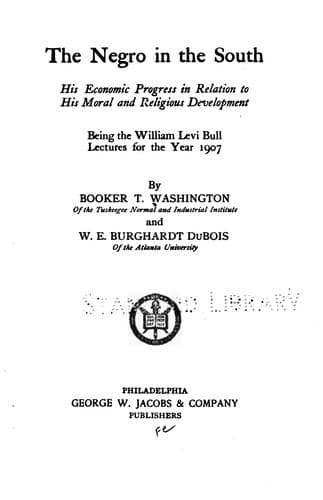
The Negro in the South: His Economic Progress in Relation to his Moral and Religious DevelopmentDu Bois, W. E. B. (William Edward Burghardt)
History
The Negro in the South: His Economic Progress in Relation to his Moral and Religious Development
Du Bois, W. E. B. (William Edward Burghardt)
African Americans -- Southern States
A discussion of this subject calls to mind one of those curious
changes in public opinion and custom with regard to races which often
occur in the United States. At the period to which I am now referring,
a great number of the Negroes in the South were compelled to follow a
trade, and they seem to have no difficulty in pursuing trades there
to-day. In the North where the agitation for the Negro's freedom
began, it is in most cases difficult, and often impossible, for a
black man to find an opportunity to work at any kind of skilled labor.
I sometimes wonder which man is the greater sinner,--the man who by
force compels the Negro to work without pay, or the man who by
physical force and through the force of public sentiment prevents the
Negro from working for him, when he is ready, willing, and fit to do
so.
I do not overstate the matter when I say that I am quite sure that in
one county in the South during the days of slavery there were more
colored youths being taught trades than there are members of my race
now being taught trades in any of the larger cities of the North.
Before I go further, I ought, in justice, to add that as slavery
spread and the owners came to know their slaves better, there appeared
in nearly every section of the South, especially in Virginia and South
Carolina, a considerable number of slave-holders who rose above the
mere idea of economic and selfish gain; and thus, through the medium
of slavery, the opportunity to train the Negro in morality and
Christianity presented itself in many sections of the South. During
the days of slavery regular religious services were provided for the
slaves, the same minister who served the white congregation preached
to the blacks. In some of the most aristocratic families, the Negro
children were taught in the Sunday-school; this was true of the Lees
and Jacksons of Virginia, and of the family of Bishop Capers and other
men of that type in South Carolina.
At the end of the period of slavery, about two hundred and fifty
years, the Negro race as a whole had learned, as I have stated, to
wear clothes, to live in a home, to work with a reasonable degree of
regularity and system, and a few had learned to work with a high
degree of skill. Not only this, the race had reached the point where,
from speaking scores of dialects, it had learned to speak
intelligently the English language. It had also a fair knowledge of
American civilization and had changed from a pagan into a Christian
race. Further, at the beginning of his freedom, the Negro found
himself in possession of--in fact had a monopoly of--the common and
skilled labor throughout the South; not only this, but, by reason of
the contact of whites and blacks during slavery, the Negro found
business and commercial careers open to him at the beginning of his
freedom.
Public-domain text, read in full here on John Shaqi.
Reviews
Reviews
No reviews yet
Be the first to share your thoughts on this work.
Join the Discussion
Join the discussion
Sign in to leave a comment or review.
Sign InorCreate an account