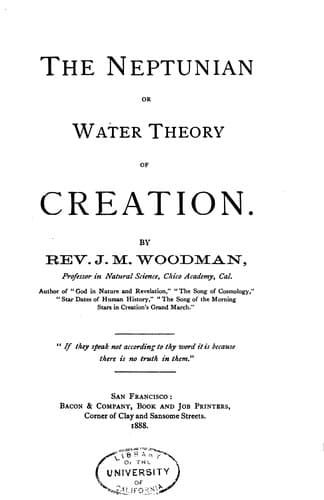
The Neptunian, or Water Theory of CreationWoodman, J. M.
Religion
The Neptunian, or Water Theory of Creation
Woodman, J. M.
Bible and science; Creation; Religion and science
5. To establish the Plutonic theory, it is at least necessary to
demonstrate that the granite, which all hold to be the under rock, is
the unstratified Plutonic foundation of all stratified rock. Recent
facts have demonstrated that the granite is a sedimentary rock, or rock
deposited in water. This being admitted, although contradicting the
teachings of all the older text books, some writers, among them is
Steel, in order to harmonize the Plutonic theory with these stubborn
facts, have assumed that the primitive granite, which by the theory must
have been trap or lava, has all been worn away by disintegration of
water and ice, or both; and again, by water deposited as we now find it.
But what was a white-hot globe of lava doing, while water and ice were
tearing and grinding its lower crust to powdered sand? We have secondary
granite, but its structure is very different from primitive granite.
Besides containing hard pebbles and boulders of other stone, it is
friable, and easily disintegrated under exposure. It is a bad theory
that is driven to such unheard-of suppositions for its support. Nothing
is more evident, if the granite is the under rock, and sedimentary, as
represented and known to be, than that the Plutonic theory is completely
without foundation.
6. The modern theory of metamorphic rock, occasioned by internal heat,
is also false. This theory maintains that the granite, slates, and
marble existed so near to the great body of internal heat that they must
have been metamorphosed. Facts demonstrate that these rocks, as a rule,
were never in heat equal to 700 deg. Fahr. Such a heat will readily
disintegrate any of these formations. Any one can demonstrate this by
melting a little lead upon a piece of slate, marble, or granite. The
furnace is found to be the best general test of the origin of rock.
Lava, having been in a melted state, will not disintegrate up to the
melting point, but, as a rule, will readily melt at the white heat.
Granite, the slates, marble, and rock in general, of a sedimentary
formation, will disintegrate at a comparatively low heat, but they will
not melt, except with alkaloids, or flux, and then only at a very high
degree of heat. This test shows all the primitive rock, including
injected seams, to have been formed in the sea, with no heat to change
their structure since. There are a few exceptions to the rule of
disintegration, as clay rock.
Public-domain text, read in full here on John Shaqi.
Reviews
Reviews
No reviews yet
Be the first to share your thoughts on this work.
Join the Discussion
Join the discussion
Sign in to leave a comment or review.
Sign InorCreate an account