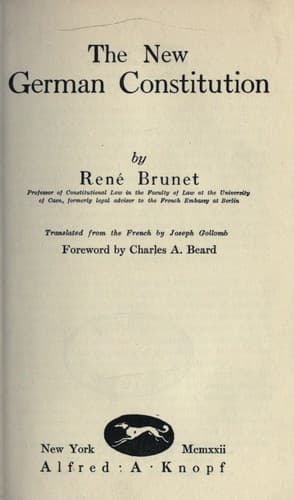
Germany -- Politics and government -- 1918-1933; Germany. Verfassung (1919)
The Assembly in addition considered itself bound to study and pass laws
of a character not necessarily constitutional but urgently needed by the
Reich. In the front rank in importance were the laws designed to create
the financial resources of which the Reich had great need in order to
meet the enormous charges imposed upon it by the treaty of peace, the
losses of five years of war and the increased public expenditure. It
was also urgent to enact laws governing pensions and indemnities to the
wounded, the mutilated, and the widows of the war, etc.
But from the moment the Constitution entered into force on August 11,
Germany was under a new constitutional régime. It was no longer the
régime of the Provisional Constitution of February 10, 1919; that
Constitution was abolished by the definitive one. Nor had it as yet
entered on the complete régime of the definitive Constitution; for that
provided for a Reichstag, and no one would dream of calling a Reichstag
to sit at the same time as the National Assembly. It was a transitional
régime; from August 12, 1919, to June 6, 1920, the Constitution of August
11 was in force but the National Assembly performed the function of
the Reichstag, and the President of the Reich, elected by the National
Assembly, remained in office until the people should elect his successor
(Article 180 of the Constitution).
In conformity with this decision on August 21, 1919, President of the
Reich, Ebert, took the oath of allegiance to the new Constitution before
the National Assembly in the course of its last session at Weimar.
From September 30 on, the Assembly sat in Berlin in the palace of
the Reichstag, where it discussed and passed important financial
legislation, which included “a law on the income tax”; another “on a
consumption tax on liquors”; and still others dealing with “factory
councils and with the relief of public distress throughout the Reich.”
In the early part of March, 1920, the parties of the Right, who hoped
by means of new elections to obtain considerable increase in strength,
submitted a proposal in which the Reich was asked to make known at once
what projects for laws it expected to submit to the Assembly before its
dissolution; and demanding that the Assembly submit as soon as possible
proposals regulating the elections to the Reichstag, the election of the
President, on initiative and referendum; and in addition proposing that
the Assembly declare itself dissolved on May 1, 1920. This motion was
defeated on March 10 after the Minister of Interior, Koch, had indicated
the laws which still remained to be enacted. He insisted on the necessity
of a profound study of the project of the law governing the election of
the Reichstag; and that the first Reichstag of the Republic should not
be elected according to the provisions of a temporary and little studied
law. He declared that the National Assembly could not be dissolved nor
the elections held before the autumn of 1920.
Public-domain text, read in full here on John Shaqi.
Reviews
Reviews
No reviews yet
Be the first to share your thoughts on this work.
Join the Discussion
Join the discussion
Sign in to leave a comment or review.
Sign InorCreate an account