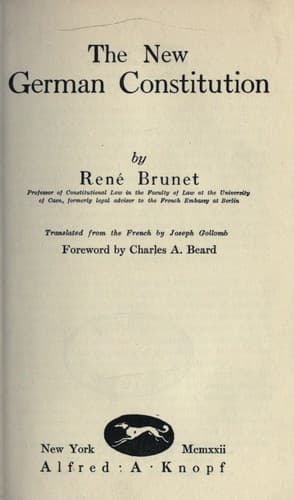
Germany -- Politics and government -- 1918-1933; Germany. Verfassung (1919)
But two days later came the _putch_ of Kapp and Lüttwitz. Berlin
fell into the hands of a military faction who announced openly their
determination to bring back the old régime. The regular government fled
to Stuttgart, where it hastily convoked the National Assembly. A general
strike was declared everywhere. Defeated by this, Kapp and Lüttwitz fled
and the regular government came back to Berlin. But the workers refused
to resume work without receiving first the guarantees they considered
necessary against the return of the military dictatorship. Then followed
also troubles in the Ruhr and the occupation of German cities on the
right bank of the Rhine by Franco-Belgian troops.
All these events were too important and upset too profoundly the
political situation to make it feasible to go on without an immediate
consultation with the people of Germany. Therefore, after hastily
enacting the last of the immediately urgent laws, particularly electoral
provisions, the Assembly dissolved at the end of May, 1920.
CHAPTER II
TOWARD A UNITARY STATE
The first question with which the National Assembly found itself
confronted and which had to be decided was whether the German Reich was
to remain a federated state or whether it was to become a unitary state;
or, supposing that an intermediate solution were obtainable, to what
extent it could partake of the characteristics of one or the other type
of state.
The unitary state possesses an undivided and exclusive sovereignty.
There is unity of law, of power and of will with one Constitution, one
administration and one authority. The type of such a unitary state is
France. To the unitary state is opposed the composite state in which
co-exist several sovereignties, those of the member states as well as
that of the central government.
For, there are two principal types of federated states: the confederation
of states, which has as its basis an international treaty and the
expression of whose will is only the sum total of the wishes of its
member states; each component state retains its sovereignty, but certain
attributes of that sovereignty are exercised in common through the
confederate organs. The other type is the federal state, which has as its
basis a constitution and which possesses a sovereignty necessary for the
performance of its duties, the exercise of its rights and its independent
will.
Public-domain text, read in full here on John Shaqi.
Reviews
Reviews
No reviews yet
Be the first to share your thoughts on this work.
Join the Discussion
Join the discussion
Sign in to leave a comment or review.
Sign InorCreate an account