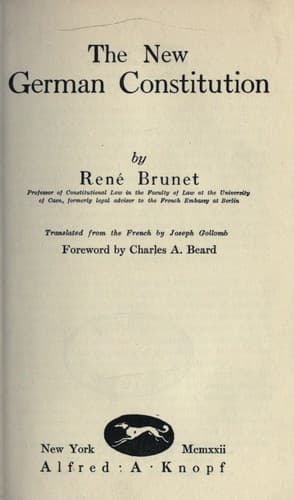
Germany -- Politics and government -- 1918-1933; Germany. Verfassung (1919)
But it goes without saying that these concepts are essentially relative.
Between the unitary state and the confederation of states lies a whole
series of state types, one merging by imperceptible nuances into the
other, types which differ one from another according to the extent to
which the member states are called upon to collaborate in the formation
of the common will. Further, the federal state is never static, in the
sense that its institutions never cease to change, tending either toward
unitarism--that is to say, toward the tightening of the federating bonds
or even toward their disappearance through the complete fusion of the
component states; or tending toward federalism, that is to say, toward a
loosening of the bonds, or even their disappearance by the dissolution of
the composite state.
There are undoubtedly in every composite state at the same time
tendencies of both kinds. Theoretically they may even act as balances
to one another. But this equilibrium is never completely realized and
according as one of these tendencies gains over the other, the composite
state tends more or less rapidly toward unitarism or toward federalism.[9]
Before the war the German Empire was a federated state with unitary
tendencies. Since the war these tendencies have strengthened. For, the
downfall of the Empire and its army, the economic catastrophe which
followed the war and aggravated the revolution, the separatist tendencies
which have shown themselves here and there on German soil, and the
financial burdens which have weighed on Germany all have convinced its
leaders that to save Germany and to build it up there was but one means
possible--to concentrate all the powers in the hands of those at the
helm of the Empire, and as a consequence, to diminish to the greatest
possible measure the powers of the member states (if not actually to
suppress them completely) in order to give all efforts available a single
direction and to utilize them to the maximum, avoiding at the same time
all unproductive energy and all scattering of forces.
By what means did this evolution manifest itself? How far did the
Constituent Assembly go toward unitarization of the Reich? Will the
German Reich remain a federated state?
To answer these questions we must successively examine: (a) whether the
states still exercise self-determination and particularly whether they
remain masters of their territory; (b) whether the states retain the
right to give themselves their individual constitutions and laws and
to govern themselves; (c) and finally whether the states participate,
as such, in the formation of the will of the Reich. This last problem
will be examined in studying the organization of the public powers,
particularly those of the Reichsrat. The present chapter will be devoted
to the study of the first two considerations.
SECTION I
TERRITORIAL STATUS OF THE STATES
Public-domain text, read in full here on John Shaqi.
Reviews
Reviews
No reviews yet
Be the first to share your thoughts on this work.
Join the Discussion
Join the discussion
Sign in to leave a comment or review.
Sign InorCreate an account