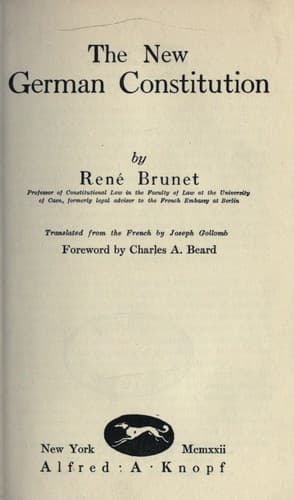
Germany -- Politics and government -- 1918-1933; Germany. Verfassung (1919)
2. The second group of subjects entering the province of the Reich’s
authority consisted of matters on which the Constitution gave to the
Reich the right to legislate _by priority_, without thereby excluding
the legislative authorities of the various states, so that there could
exist _concurrent legislation_ in the Reich and in the States, the states
retaining the right to legislate as long as the Reich does not use its
own right to legislate on these matters.
This group is defined in the Constitution by Articles 7, 8 and 9.
Article 7 sums up briefly, as did Article 4 of the old Constitution,
the province of concurrent legislation, but adds considerably to the
enumeration strengthening here the unity of the Reich and adding to the
subjects which enter into the concurrent legislative competence of the
Reich all such important matters as assistance and care to be given
to mothers, infants, children and youths; also questions relating to
professional representation, to the socialization of natural wealth,
to economic enterprises as well as the organization of collective
enterprises. To this, strengthening still further the competence of the
Reich, Article 12, Section 2, adds that the government of the Reich has
the right to veto laws passed by the states dealing with socialization,
if these laws touch the well-being of the whole population of the Reich.
Article 8 introduces in the Constitution, in spite of the violent
opposition of the states, the principle of financial sovereignty of the
Reich and fiscal centralization therein. This article gives to the Reich
the right to take possession of all sources of revenue, stipulating,
however, that it must leave to the states resources sufficient for their
existence. This provision constitutes an important advance along the road
to the unity of the Reich and strengthens considerably the financial
competence of the Reich compared to its former situation.
Article 9 also deals with the concurrent authority of the Reich in
matters concerning the public weal and the protection of order and
public security; but under this head there is the limitation, “to the
extent that it shall become necessary to pass uniform legislation.”
This limitation, however, is of no particular importance, for as with
the matters dealt with in Article 7 the Reich does not make use of its
right of legislation except as it feels the need for it. The restriction
provided by Article 9 is explained by the fact that the authority of the
Reich in these matters naturally met resistance on the part of the states
and that a compromise had to be effected; they came to the agreement that
the Reich would not take up these questions in advance and in the first
instance.
Public-domain text, read in full here on John Shaqi.
Reviews
Reviews
No reviews yet
Be the first to share your thoughts on this work.
Join the Discussion
Join the discussion
Sign in to leave a comment or review.
Sign InorCreate an account