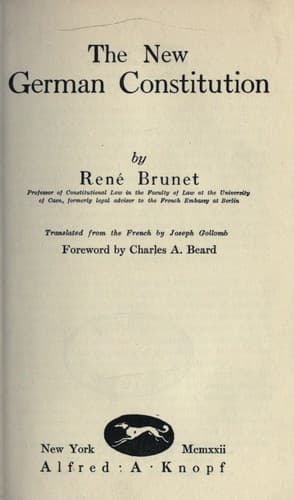
Germany -- Politics and government -- 1918-1933; Germany. Verfassung (1919)
3. In a third series of cases, finally, the states have exclusive
competence. _They may both legislate and administer._
Of these three hypotheses the one most important from our present point
of view is the first. The recognized right of the Reich to have public
services designed to apply its laws and acts, permits it to organize
public administrations and to have functionaries subordinate directly
to the Reich throughout the whole German territory. The unity of the
Reich is greatly strengthened by the fact that the principal public
services--the army, finances, diplomatic corps, postal telegraphs,
railroads--are hereafter completely concentrated in its hands.
In addition when the Reich fails to organize its own administration or
when it has left to the states the task of legislating on subjects that
are contained in the legislative competence of the Reich, the latter is
far from being weakened in its power therein. For it possesses in such
cases the _Right of Control_ over the administrative authorities of these
states, and this right was notably strengthened by the Constitution of
1919 as compared to its former power.
According to the terms of Article 15, paragraph 2, control by the Reich
may be exercised by the government of the Reich in matters on which the
latter has the right to legislate. That means that control on the part
of the Reich extends not only to the domains which have been already
assigned to it by the legislation of the Reich, but also to matters in
which it has the right to legislate even though it has not yet made use
of such right.
The means by which these rights of control are exercised are the
following:
(a) General instructions addressed to the authorities of the states
for the execution of the laws of the Reich. These instructions of the
government of the Reich are compulsory on the different authorities of
the states. But instructions to subordinate authorities of these states
must not be given in particular applications of these laws, for otherwise
these authorities might receive contradictory orders from different
sources; and in that way the governments of the state might lose all
authority.
(b) The control of the Reich is exercised in addition by sending to the
governments of the states commissioners charged with the supervising of
the execution of the laws of the Reich. Such commissioners may even be
sent, with the consent of the governments of the states, to subordinate
authorities. In the latter case it must be admitted even that the Reich
has the right to demand that the files of the state authorities be opened
to it and with the consent of the governments of the states the Reich may
examine witnesses, take testimony and make surveys within the provinces
of the state.
(c) Finally the Reich may demand that lapses observed in the execution of
its laws be corrected.
Public-domain text, read in full here on John Shaqi.
Reviews
Reviews
No reviews yet
Be the first to share your thoughts on this work.
Join the Discussion
Join the discussion
Sign in to leave a comment or review.
Sign InorCreate an account