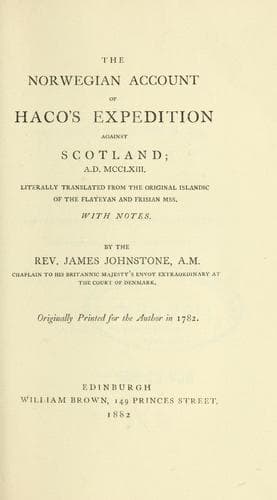
The Norwegian account of Haco's expedition against Scotland, A.D. MCCLXIII.Sturla Þórðarson
History
The Norwegian account of Haco's expedition against Scotland, A.D. MCCLXIII.
Sturla Þórðarson
Haakon IV Haakonsson, King of Norway, 1204-1263; Norway -- History -- 1030-1397; Scandinavians; Scotland -- History -- To 1603
[Footnote 30: Gestil, a famous sea king or pirate.]
[Footnote 31: _Th_areyiar-fioerd (_orig._), perhaps a mistake for
Faroeyiar-fioerd. Torfaeus read it Barreyiarfiord.]
[Footnote 32: _i.e._, the column of pillars, perhaps the island
Staffa.]
[Footnote 33: _i.e._, the promontory of deer, now
Durnish.]
[Footnote 34: 7th of July.]
[Footnote 35: The Norwegians computed by winters: the Scotch did the
same, as we see by Winton's chronicle:
"Thretty winters and four than
Edan regnyd Max Gowran."
]
[Footnote 36: Val-drosar (_orig._), the Goddesses of Fate, or
Valkyriae, to whom armour was supposed sacred.]
[Footnote 37: _i.e._, Tribute--Ringa elldingom, (_orig._), bright
rings: _Ringa_ signify not only rings, or bracelets, but also money;
for before the introduction of coinage into the North, very thick
spiral gold wires were worn round the wrists of great men, who
distributed bits to those who performed any signal service; and such a
wire is still to be seen in the Royal Museum at Copenhagen. It is not
always easy to discern when by _ringa_ is understood ornaments for the
fingers, bracelets, rings of investiture, or the current money of the
times.]
[Footnote 38: _i.e._, the islet, a monastery near Bergen.]
[Footnote 39: Afterwards chancellor of Norway.]
[Footnote 40: Probably the son of Dugal, the son of Somerled.]
[Footnote 41: The father of King Dugal was Rory, I suppose. See notes
on pages 34 and 42.]
[Footnote 42: Nephew to Sturla author of the Ravens-ode. He attended
Haco in this expedition.]
[Footnote 43: _i.e._ ships.]
[Footnote 44: _i.e._ sails.]
[Footnote 45: Bla-dufor (_orig._), _i.e._ Blue pigeons. The Scalds
frequently compared ships under sail to birds, horses, and other
animals in motion.]
[Footnote 46: _i.e._ gold.]
[Footnote 47: _i.e._ ship.]
[Footnote 48: Kirkio-vog (_orig._) _i.e._ Church-bay. Kirkwall.]
[Footnote 49: Breida-fiardar (_orig._), _i.e._ Broad bay. The firth of
Forth.]
[Footnote 50: St Olave's day, July 29.]
[Footnote 51: Mula in Irish and Icelandic signifies a cape or beak.]
[Footnote 52: Kata-nes (_orig._), _i.e._ the promontory of Cadtav or
Cathness. Cathness was particularly exposed to the inroads of the
Norwegians. On this account great numbers of the inhabitants retired
into Murray and the adjacent counties, where they were afterwards
known by the name of Clan-Chattan.]
[Footnote 53: _i.e._, the promontory, or Cathness.]
[Footnote 54: Baug-gerdar (_orig._), _i.e._ imposer of rings. _Baug_
signifies anything circular, therefore, in compounded words, it is not
easy to discern when it denotes rings or shields, &c. See note on
_ringa_, p. 19.]
[Footnote 55: This eclipse happened on the 5th of August 1263.]
[Footnote 56: St Laurence's wake or vigil, 9th of Aug.]
[Footnote 57: Cathness by the ancient Britons was called Pentir,
_i.e._ the headland, whence the neighbouring firth had its name.]
[Footnote 58: _i.e._ John the Queen, perhaps the ancestor of the
McQueens.]
Public-domain text, read in full here on John Shaqi.
Reviews
Reviews
No reviews yet
Be the first to share your thoughts on this work.
Join the Discussion
Join the discussion
Sign in to leave a comment or review.
Sign InorCreate an account