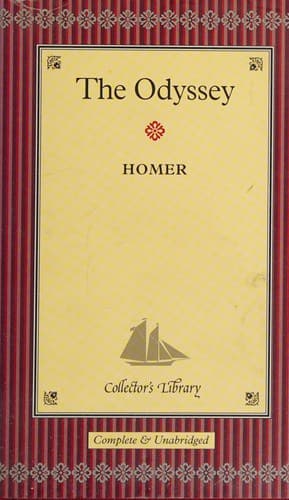
Epic poetry, Greek -- Translations into English; Homer -- Translations into English; Odysseus, King of Ithaca (Mythological character) -- Poetry
And it was this supposed unity of authorship which gave these poems
their powerful influence over the minds of the men of old. Heeren, who
is evidently little disposed in favour of modern theories, finely
observes:—
“It was Homer who formed the character of the Greek nation. No poet has
ever, as a poet, exercised a similar influence over his countrymen.
Prophets, lawgivers, and sages have formed the character of other
nations; it was reserved to a poet to form that of the Greeks. This is
a feature in their character which was not wholly erased even in the
period of their degeneracy. When lawgivers and sages appeared in
Greece, the work of the poet had already been accomplished; and they
paid homage to his superior genius. He held up before his nation the
mirror in which they were to behold the world of gods and heroes, no
less than of feeble mortals, and to behold them reflected with purity
and truth. His poems are founded on the first feeling of human nature;
on the love of children, wife, and country; on that passion which
outweighs all others, the love of glory. His songs were poured forth
from a breast which sympathized with all the feelings of man; and
therefore they enter, and will continue to enter, every breast which
cherishes the same sympathies. If it is granted to his immortal spirit,
from another heaven than any of which he dreamed on earth, to look down
on his race, to see the nations from the fields of Asia, to the forests
of Hercynia, performing pilgrimages to the fountain which his magic
wand caused to flow; if it is permitted to him to view the vast
assemblage of grand, of elevated, of glorious productions, which had
been called into being by means of his songs; wherever his immortal
spirit may reside, this alone would suffice to complete his happiness.”
Can we contemplate that ancient monument, on which the “Apotheosis of
Homer” is depictured, and not feel how much of pleasing association,
how much that appeals most forcibly and most distinctly to our minds,
is lost by the admittance of any theory but our old tradition? The more
we read, and the more we think—think as becomes the readers of
Homer,—the more rooted becomes the conviction that the Father of Poetry
gave us this rich inheritance, whole and entire. Whatever were the
means of its preservation, let us rather be thankful for the treasury
of taste and eloquence thus laid open to our use, than seek to make it
a mere centre around which to drive a series of theories, whose
wildness is only equalled by their inconsistency with each other.
As the hymns, and some other poems usually ascribed to Homer, are not
included in Pope’s translation, I will content myself with a brief
account of the Battle of the Frogs and Mice, from the pen of a writer
who has done it full justice:—
Public-domain text, read in full here on John Shaqi.
Reviews
Reviews
No reviews yet
Be the first to share your thoughts on this work.
Join the Discussion
Join the discussion
Sign in to leave a comment or review.
Sign InorCreate an account