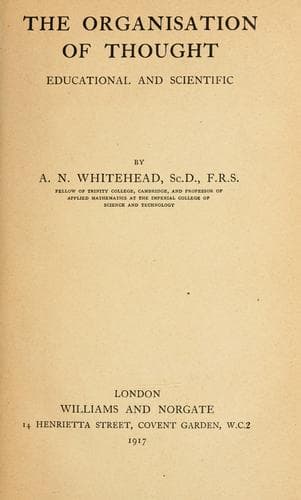
The organisation of thought, educational and scientific — John Shaqi
The organisation of thought, educational and scientificWhitehead, Alfred North
Philosophy
The organisation of thought, educational and scientific
Whitehead, Alfred North
Education
Disinterested scientific curiosity is a passion for an ordered
intellectual vision of the connection of events. But the goal of
such curiosity is the marriage of action to thought. This essential
intervention of action even in abstract science is often overlooked. No
man of science wants merely to know. He acquires knowledge to appease
his passion for discovery. He does not discover in order to know, he
knows in order to discover. The pleasure which art and science can
give to toil is the enjoyment which arises from successfully directed
intention. Also it is the same pleasure which is yielded to the
scientist and to the artist.
The antithesis between a technical and a liberal education is
fallacious. There can be no adequate technical education which is not
liberal, and no liberal education which is not technical: that is, no
education which does not impart both technique and intellectual vision.
In simpler language, education should turn out the pupil with something
he knows well and something he can do well. This intimate union of
practice and theory aids both. The intellect does not work best in a
vacuum. The stimulation of creative impulse requires, especially in
the case of a child, the quick transition to practice. Geometry and
mechanics, followed by workshop practice, gain that reality without
which mathematics is verbiage.
There are three main methods which are required in a national system of
education, namely, the literary curriculum, the scientific curriculum,
the technical curriculum. But each of these curricula should include
the other two. What I mean is, that every form of education should give
the pupil a technique, a science, an assortment of general ideas, and
æsthetic appreciation, and that each of these sides of his training
should be illuminated by the others. Lack of time, even for the most
favoured pupil, makes it impossible to develop fully each curriculum.
Always there must be a dominant emphasis. The most direct æsthetic
training naturally falls in the technical curriculum in those cases
when the training is that requisite for some art or artistic craft. But
it is of high importance in both a literary and a scientific education.
The educational method of the literary curriculum is the study of
language, that is, the study of our most habitual method of conveying
to others our states of mind. The technique which should be acquired
is the technique of verbal expression, the science is the study of the
structure of language and the analysis of the relations of language
to the states of mind conveyed. Furthermore, the subtle relations of
language to feeling, and the high development of the sense organs
to which written and spoken words appeal, lead to keen æsthetic
appreciations being aroused by the successful employment of language.
Finally, the wisdom of the world is preserved in the masterpieces of
linguistic composition.
Public-domain text, read in full here on John Shaqi.
Reviews
Reviews
No reviews yet
Be the first to share your thoughts on this work.
Join the Discussion
Join the discussion
Sign in to leave a comment or review.
Sign InorCreate an account