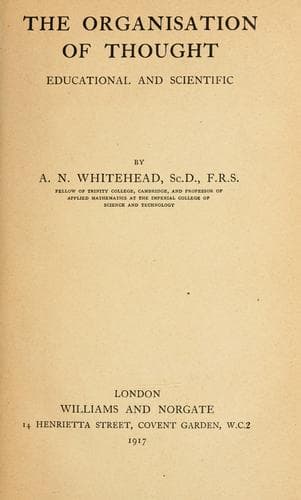
The organisation of thought, educational and scientificWhitehead, Alfred North
Philosophy
The organisation of thought, educational and scientific
Whitehead, Alfred North
Education
This curriculum has the merit of homogeneity. All its various parts
are co-ordinated and play into each other's hands. We can hardly be
surprised that such a curriculum, when once broadly established, should
have claimed the position of the sole perfect type of education. Its
defect is unduly to emphasise the importance of language. Indeed the
varied importance of verbal expression is so overwhelming that its
sober estimation is difficult. Recent generations have been witnessing
the retreat of literature, and of literary forms of expression, from
their position of unique importance in intellectual life. In order
truly to become a servant and a minister of nature something more is
required than literary aptitudes.
A scientific education is primarily a training in the art of observing
natural phenomena, and in the knowledge and deduction of laws
concerning the sequence of such phenomena. But here, as in the case of
a liberal education, we are met by the limitations imposed by shortness
of time. There are many types of natural phenomena, and to each type
there corresponds a science with its peculiar modes of observation,
and its peculiar types of thought employed in the deduction of laws. A
study of science in general is impossible in education, all that can be
achieved is the study of two or three allied sciences. Hence the charge
of narrow specialism urged against any education which is primarily
scientific. It is obvious that the charge is apt to be well-founded;
and it is worth considering how, within the limits of a scientific
education and to the advantage of such an education, the danger can be
avoided.
Such a discussion requires the consideration of technical education. A
technical education is in the main a training in the art of utilising
knowledge for the manufacture of material products. Such a training
emphasises manual skill, and the co-ordinated action of hand and
eye, and judgment in the control of the process of construction. But
judgment necessitates knowledge of those natural processes of which the
manufacture is the utilisation. Thus somewhere in technical training
an education in scientific knowledge is required. If you minimise
the scientific side, you will confine it to the scientific experts;
if you maximise it, you will impart it in some measure to the men,
and--what is of no less importance--to the directors and managers of
the businesses.
Technical education is not necessarily allied exclusively to science
on its mental side. It may be an education for an artist or for
apprentices to an artistic craft. In that case æsthetic appreciation
will have to be cultivated in connection with it.
Public-domain text, read in full here on John Shaqi.
Reviews
Reviews
No reviews yet
Be the first to share your thoughts on this work.
Join the Discussion
Join the discussion
Sign in to leave a comment or review.
Sign InorCreate an account