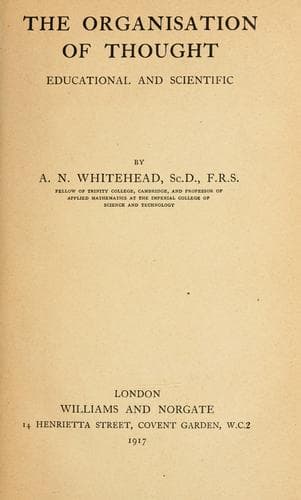
The organisation of thought, educational and scientific — John Shaqi
The organisation of thought, educational and scientificWhitehead, Alfred North
Philosophy
The organisation of thought, educational and scientific
Whitehead, Alfred North
Education
An evil side of the Platonic culture has been its total neglect of
technical education as an ingredient in the complete development
of ideal human beings. This neglect has arisen from two disastrous
antitheses, namely, that between mind and body, and that between
thought and action. I will here interject, solely to avoid criticism,
that I am well aware that the Greeks highly valued physical beauty and
physical activity. They had, however, that perverted sense of values
which is the nemesis of slave-owning.
I lay it down as an educational axiom that in teaching you will come
to grief as soon as you forget that your pupils have bodies. This is
exactly the mistake of the post-renaissance Platonic curriculum. But
nature can be kept at bay by no pitchfork; so in English education,
being expelled from the classroom, she returned with a cap and bells in
the form of all-conquering athleticism.
The connections between intellectual activity and the body, though
diffused in every bodily feeling, are focussed in the eyes, the ears,
the voice, and the hands. There is a co-ordination of senses and
thought, and also a reciprocal influence between brain activity and
material creative activity. In this reaction the hands are peculiarly
important. It is a moot point whether the human hand created the human
brain, or the brain created the hand. Certainly the connection is
intimate and reciprocal. Such deep-seated relations are not widely
atrophied by a few hundred years of disuse in exceptional families.
The disuse of hand-craft is a contributory cause to the brain-lethargy
of aristocracies, which is only mitigated by sport where the concurrent
brain-activity is reduced to a minimum and the hand-craft lacks
subtlety. The necessity for constant writing and vocal exposition is
some slight stimulus to the thought-power of the professional classes.
Great readers, who exclude other activities, are not distinguished by
subtlety of brain. They tend to be timid conventional thinkers. No
doubt this is partly due to their excessive knowledge outrunning their
powers of thought; but it is partly due to the lack of brain-stimulus
from the productive activities of hand or voice.
Public-domain text, read in full here on John Shaqi.
Reviews
Reviews
No reviews yet
Be the first to share your thoughts on this work.
Join the Discussion
Join the discussion
Sign in to leave a comment or review.
Sign InorCreate an account