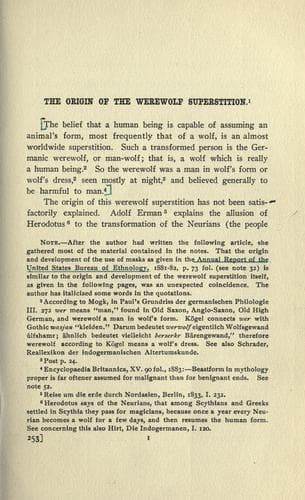
The Origin of the Werewolf SuperstitionStewart, Caroline Taylor
History
The Origin of the Werewolf Superstition
Stewart, Caroline Taylor
Werewolves
to such demoniacal metamorphosis, gave rise to the werewolf
superstition of the Middle Ages. The theory that if one put on
a wolf’s skin he became a werewolf, is perhaps a reminiscence
of the fact alleged of Berserkers haunting the woods by
_night_, clothed in hides of wolves or bears. A permanent cure
was effected by burning the werewolf’s sack, unless the Devil
furnished him with a new wolfskin. Primitively, to become
incarnated into any creature, the soul had only to put on the
outward integument of the creature. The original werewolf is
the night-wind—a kind of leader of departed souls, howling
in the wintry blasts. Encyc. Brit, under Lycanthropy:—The
Berserkir of Iceland dressed in the skins of bears and wolves,
and further on: “Beastform is in mythology proper far oftener
assumed for malignant than for benignant ends.”
The starting point of the whole superstition of the harmful werewolf
is the disguising as some common animal by members of savage races
when abroad as foragers or scouts, in order to escape detection by the
enemy. Like wolves they roamed the land in search of food. As stated
above,[103] later fabulous report would represent them as possessing
in their disguise the attributes of the animal they impersonated,[104]
and finally even of actually taking on animal form, either wholly or
in part,[105] for longer or shorter periods of time. Some of the North
American Indian transformation stories represent men as having only
the head, hands and feet of a wolf.[106] The transformation into a
werewolf in Germanic lands is caused merely by a shirt or girdle made
of wolf-skin.[107] This shirt or girdle of wolf-skin of the Germanic
werewolf is the survival of the robe or mantle originally disguising
the entire body. It would be but a step further to represent a person
as rendering himself invisible by putting on any other article of
apparel, such as the Tarnkappe.[108] The stories especially in Europe
were of the _were-wolf_ rather than _were-bear_ or other animal,
because the wolf was the commonest of the larger wild animals.[109] It
was the stories of the commonest animal, the wolf, which crystallized
into the household werewolf or transformation tales.[110]
[103] Ante p. 22.
[104] Note 57.
[105] Close note 65.
[106] Grinnell; and Ethn. Rep. 1888-89, p. 737.
Public-domain text, read in full here on John Shaqi.
Reviews
Reviews
No reviews yet
Be the first to share your thoughts on this work.
Join the Discussion
Join the discussion
Sign in to leave a comment or review.
Sign InorCreate an account