The Origin of the Werewolf SuperstitionStewart, Caroline Taylor
History
The Origin of the Werewolf Superstition
Stewart, Caroline Taylor
Werewolves
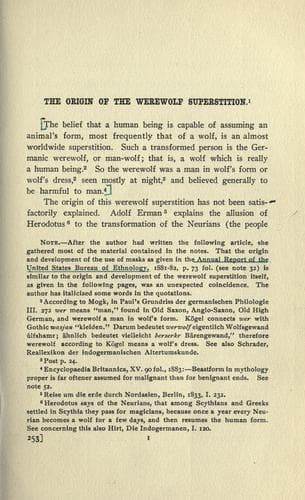
[107] Grimm, Teutonic Mythology, III. 1094, fol. says: Our
oldest native notions make the assumption of wolf-shape
depend on arraying oneself in a wolf-belt or wolf-shirt, as
transformation into a swan does on putting on the swan-shirt
or swan-ring. Page 1095: “The transformation need not be for a
magical purpose at all: any one that puts on, or is conjured
into, a wolf-shirt, will undergo metamorphosis.... With the
appearance, he acquires also the fierceness and howling of the
wolf; roaming the _woods_, he rends to pieces everything that
comes in his way.” This is like the belief of the American
Indian that the wearer of a mask becomes imbued with the spirit
of the being which his mask represents (note 57); or that the
shaman in full regalia becomes, or tries to make his followers
believe that he has become, the power he represents (note 67).
[108] Thus some American Indian stories represent men
transformed into wolf, turkey or owl turning into stone or
piece of decayed wood when pursued. And mantles of invisibility
are mentioned in note 60.
[109] See Hirt, Die Indogermanen, I. 187: “Unter den grossen
Raubtieren treten uns Bär und Wolf mit alten Namen entgegen.
Der Wolf ist freilich überall in Europa verbreitet gewesen, der
Bär ist aber ganz sicher ein Waldtier,” etc. Encyc. Brit, under
Lycanthropy: “In England by the 17th century the werewolf had
long been extinct. Only small creatures, the cat, hare, weasel,
etc., remained for the malignant sorcerer to transform himself
into.” See note 11.
Public-domain text, read in full here on John Shaqi.
Reviews
Reviews
No reviews yet
Be the first to share your thoughts on this work.
Join the Discussion
Join the discussion
Sign in to leave a comment or review.
Sign InorCreate an account