The Origin of the Werewolf SuperstitionStewart, Caroline Taylor
History
The Origin of the Werewolf Superstition
Stewart, Caroline Taylor
Werewolves
Meyer’s Kleines konversations-lexikon:—Der wolf “ist häufig
in Ost- und Nordeuropa, Mittel- und Nordasien, Nordamerika,
seltener in Frankreich und Belgien, den Herden gefährlich,
besonders in Russland.” Encyc. Brit., XXIV under _Wolf_:—In
northern countries the wolf is generally larger and more
powerful than in the southern portion of its range. Its habits
are similar everywhere. It has from time immemorial been known
to man in all the countries it inhabits as the devastator of
his flocks of sheep. It has speed and remarkable endurance.
They usually assemble in troops or packs, except in summer, and
by their combined and persevering efforts are able to overpower
and kill even such great animals as the American bison.
Children and even grown people are not infrequently attacked by
them when pressed for hunger. The ferocity of the wolf in the
wild state is proverbial. Even when tamed, they can rarely be
trusted by strangers.
[13] Paul, Grundriss, III. 272.
[14] Gustav Freytag, Bilder aus neuer zeit, Leipzig, 1904, p.
275 fol., speaking of the Polish borderlands, says: “Noch lebte
das Landvolk in ohnmächtigem Kampf mit den Heerden der Wölfe,
wenig Dörfer, welchen nicht in jedem Winter Menschen und Thiere
decimirt wurden,” and in the same note 2, pp. 275-6:—“Als 1815
die gegenwärtige Provinz Posen an Preussen zurückfiel, waren
auch dort die Wölfe eine Landplage. Nach Angaben der Posener
Provinzialblätter wurden im Regierungsbezirk Posen vom 1. Sept.
1815 his Ende Februar 1816, 41 Wölfe erlegt, noch im Jahre 1819
im Kreise Wongrowitz 16 Kinder und 3 Erwachsene von Wölfen
gefressen.”
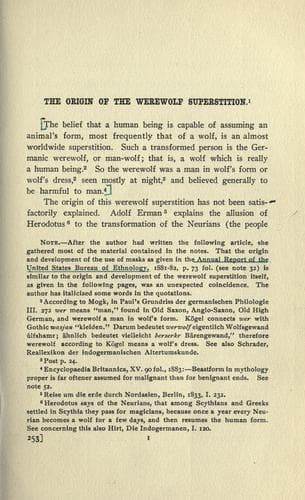
The werewolf superstition is an old one, a primitive one.[15] The
point in common everywhere is the transformation of a living human
being into an animal, into a wolf in regions where the wolf was
common[16] into a lion, hyena or leopard in Africa, where these animals
are common; into a tiger or serpent in India;[17] in other localities
into other animals characteristic of the region.[18] Among Lapps
and Finns occur transformations into the bear, wolf, reindeer, fish
or birds; amongst many North Asiatic peoples, as also some American
Indians, into the bear; amongst the latter also into the fox, wolf,
turkey or owl; in South America, besides into a tiger or jaguar,
also into a fish, or serpent. Most universal though it seems was the
transformation into wolves or dogs.[19]
Public-domain text, read in full here on John Shaqi.
Reviews
Reviews
No reviews yet
Be the first to share your thoughts on this work.
Join the Discussion
Join the discussion
Sign in to leave a comment or review.
Sign InorCreate an account