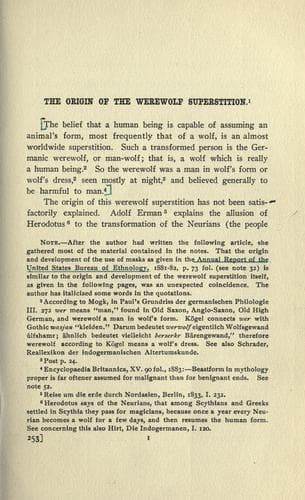
The Origin of the Werewolf SuperstitionStewart, Caroline Taylor
History
The Origin of the Werewolf Superstition
Stewart, Caroline Taylor
Werewolves
[15] Thus in note 6 was mentioned Herodotus’ (484-425 B. C.)
statement about the Neurians. The oldest werewolf legend,
according to Hertz, is that of Lykaon, the son of Pelasgos,
the first king of ancient Arcadia. These Arcadians lived as
huntsmen and shepherds. According to J. Oppert (Andree, p. 65;
and notes 6 and 9) the werewolf superstition existed amongst
the Assyrians; and Andree states, the oldest Hellenic werewolf
myth is found in Pausanias (died 467 B. C). In the Norse “Edda”
we find Odin’s wolves, also Sköll, Hati and Fenrir. In the
Völsunga Saga, Sigmund and Sinfjötli become wolves. For other
reflections of the fear in which wolves were held, see the
10th century ms. of the “Wiener Hundesegen” against male and
female wolves (Braune, Althochdeutsches Lesebuch, 6. aufl.
1907, p. 85). Jacob Grimm,—Geschichte der deutschen sprache
s. 233:—“Unsere thierfabel stellt vortrefflich das gebannte
raubthier des waldes dar, und lehrt die nähe des wolfs und
fuchses.”
C. Lemcke, Aesthetik, 6. aufl. II. 1890, s. 562:—“In die
ältesten Zeiten hinauf reicht auch bei Jägervölkern die
Tiersage, in ihrer Weise zum Teil die Eigentümlichkeiten der
Tiere erklärend, ihr Gebahren erzählend. Die furchtbaren und
die listigen Tiere boten sich am besten dar.... Wo die Menschen
städtisch beisammen wohnen, bleibt Tier Tier; wo sie einsamer
mit Tieren leben, bekommen diese eine höhere Bedeutung. So wird
dem Wäldler Bär und Wolf zum ebenbürtigen Räuber und Kämpfer,
menschlicher aufgefasst zum Gegner voll Mut, List, Rachsucht,
der Gedanken hat wie der Mensch selbst.”
[16] Volhynia, Europe, Northern Asia. Formerly, according to
Andree, p. 65, the wolf was as common throughout Europe as it
is to-day in Russia. Hirt, Die Indogermanen, I. 187, says: “Der
Wolf ist überall in Europa verbreitet gewesen, der Bär ist aber
ganz sicher ein Waldtier.”
[17] Note 9.
[18] Cf. note 9, Encyc. Brit.
[19] Leubuscher, p. 1:—Weil die Verwandlung vorzugsweise in
Hunde und Wölfe geschehen sollte, so erhielt die Krankheit den
namen Lykanthropie.
As the superstition is so widespread—Germany, Eastern Europe, Africa,
Asia, America, it either arose at a very early time, when all these
peoples were in communication with each other[20] or else, in accord
with another view of modern science, it arose independently in various
continents in process of the natural psychical development of the human
race under similar conditions.
Public-domain text, read in full here on John Shaqi.
Reviews
Reviews
No reviews yet
Be the first to share your thoughts on this work.
Join the Discussion
Join the discussion
Sign in to leave a comment or review.
Sign InorCreate an account