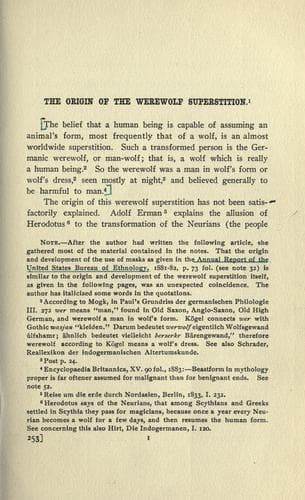
The Origin of the Werewolf SuperstitionStewart, Caroline Taylor
History
The Origin of the Werewolf Superstition
Stewart, Caroline Taylor
Werewolves
[27] Grinnell, Story of the indian, p. 54, says:—Traces of the
fear in which buffalo “were held may still be discovered in the
traditional stories of certain tribes, which set forth how, in
those days,” [i. e. in the stone age] “before men were provided
with arms, the buffalo used to chase, kill, and eat the
people. Such tales show very clearly how greatly the buffalo
were dreaded in ancient times, and such fear could hardly
have arisen save as the result of actual experience of their
power to inflict injury and death.” Pliny informs us how the
Romans kept the wolf out of their fields, see Grimm, Teutonic
Mythology, III. 1241. Whether the Indians lived on the steppes,
in the woods, on the coast, or in the mountains, the animals
were their whole study. They moved with the animals, followed
them for food.
[28] Note 27.
Very soon various ingenious contrivances were devised for trapping
them. No doubt one primitive method was the use of decoys to lure
animals into a trap. Some could be lured by baits, others more easily
by their kind. Occasionally masks were used,[29] and similarly, another
form of the original decoy was no doubt simply the stuffed skin of a
member of the species, whether animal or bird, say for example a wild
duck.[30] Of course the hunter would soon hit on the plan of himself
putting on the animal skin, in the case of larger animals; that is, an
individual dressed for example in a wolf’s skin could approach near
enough to a solitary wolf to attack it with his club, stone or other
weapon, without exciting the wolf’s suspicion of the nearness of a
dangerous foe.[31] So the animal disguise, entire or partial, was used
by early man acting in the capacity of a decoy, firstly, to secure
food and clothing. Secondly, he would assume animal disguise, whole
or partial, in dancing and singing; and both these accomplishments
seem to have arisen from the imitation of the motions and cries of
animals,[32] at first to lure them, when acting as a decoy. With growth
of culture came growth of supernaturalism, and an additional reason for
acquiring dance and song was to secure charms against bodily ills,[33]
and finally enlivenment.[34] In both dance and song, when used for a
serious purpose, the performers imagined themselves to be the animals
they were imitating,[35] and in the dance they wore the skins of the
animals represented.[36]
Public-domain text, read in full here on John Shaqi.
Reviews
Reviews
No reviews yet
Be the first to share your thoughts on this work.
Join the Discussion
Join the discussion
Sign in to leave a comment or review.
Sign InorCreate an account