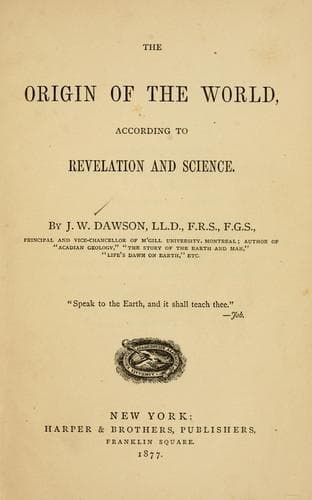
The Origin of the World According to Revelation and ScienceDawson, John William, Sir
Religion
The Origin of the World According to Revelation and Science
Dawson, John William, Sir
Bible and science; Religion and science
We have, however, no positive proof of such a theory, and it is
subject to many grave objections. The narrative itself makes no
pretension to a scientific origin, it quotes no authority, and it is
connected with no philosophical speculations or deductions. It bears
no internal evidence of having been the result of inductive inquiry,
but appeals at once to faith in the truth of the great ultimate
doctrine of absolute creation, and then proceeds to detail the steps
of the process, in the manner of history as recorded by a witness, and
not in the manner of science tracing back effects to their causes.
Farther, it refers to conditions of our planet respecting which
science has even now attained to no conclusions supported by evidence,
and is not in a position to make dogmatic assertions. The tone of all
the ancient cosmogonies has in these respects a resemblance to that
of the Scriptures, and bears testimony to a general impression
pervading the mind of antiquity that there was a divine and
authoritative testimony to the facts of creation, distinct from
history, philosophical speculation, or induction.
One of the boldest and simplest methods of this kind is that followed
by the authors of the "Types of Mankind," in the attempt to assign a
purely human origin to Genesis 1st. These writers admit the greater
antiquity of the first chapter, though assigning the whole of the book
to a comparatively modern date. They say:
"The 'document Jehovah'[13] does not especially concern our present
subject; and it is incomparable with the grander conception of the
more ancient and unknown writer of Genesis 1st. With extreme felicity
of diction and conciseness of plan, the latter has defined the most
philosophical views of antiquity upon _cosmogony_; in fact so well
that it has required the palaeontological discoveries of the nineteenth
century--at least 2500 years after his death--to overthrow his
_septenary_ arrangement of 'Creation;' which, after all, would still
be correct enough in great principles, were it not for one individual
oversight and one unlucky blunder; not exposed, however, until long
after his era, by post-Copernican astronomy. The oversight is where he
wrote (Gen. i. 6-8), 'Let there be _raquie_,' _i. e._, a _firmament_;
which proves that his notions of 'sky' (solid like the concavity of a
copper basin, with _stars_ set as brilliants in the metal) were the
same as those of adjacent people of his time--indeed, of all men
before the publication of Newton's 'Principia' and of Laplace's
'Mecanique Celeste.' The blunder is where he conceives that _aur_,
'light,' and _iom_, 'day' (Gen. i. 14-18), could have been physically
possible _three whole days_ before the 'two great luminaries,' _Sun_
and _Moon_, were created. These venial errors deducted, his majestic
song beautifully illustrates the simple process of ratiocination
through which--often without the slightest historical proof of
Public-domain text, read in full here on John Shaqi.
Reviews
Reviews
No reviews yet
Be the first to share your thoughts on this work.
Join the Discussion
Join the discussion
Sign in to leave a comment or review.
Sign InorCreate an account