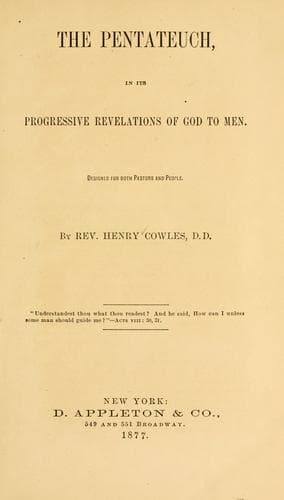
The Pentateuch, in Its Progressive Revelations of God to Men — John Shaqi
The Pentateuch, in Its Progressive Revelations of God to MenCowles, Henry
Religion
The Pentateuch, in Its Progressive Revelations of God to Men
Cowles, Henry
Bible. Pentateuch -- Criticism, interpretation, etc.
In natural order, the next lesson like this, is _God in
providence_――God administering the agencies of earthly good or ill,
making his presence manifest among his intelligent and moral offspring,
and even “coming down to see” (as the early record has it) what men
were doing and whether the cry coming up to him told truthfully of the
guilty violence perpetrated by man upon his fellows. This idea――God
ruling over the race in righteous retribution for their good or
evil deeds――was obviously one of the first great moral lessons to be
illustrated, enforced, impressed. So vital is this conviction to the
ends of a moral government that it should not surprise us if the actual
administration of present rewards and punishments in the common course
of human life in this world should be made far more prominent and
palpable in the early than in the later ages of the race, so much so as
to force itself upon the dullest eyes and compel the attention of the
most stupid and reluctant observers.――――Such (we shall have occasion
to notice) was unquestionably the divine policy throughout the earlier
stages of human history, abundantly apparent in the records of the
Bible. In later times, the exigencies of a system of probation, and
especially the importance of giving large scope to _faith_, after
sufficient evidence has been afforded, served to impose narrower limits
upon present retribution, reserving the larger share to the perfect
adjustments of the great future. In the earlier stages of human history,
it would obviously be vital to give men sufficient demonstration that
God _does rule_, and therefore is to be believed when he threatens to
punish either here or hereafter, and consequently is evermore to be
_feared_ as the certain avenger of crime. Hence the imperative need
in those early ages of such manifestations of God’s justice as would
impress the _fear_ of his name. With our eye open to the native pride
of depraved souls and to their appalling tendency to disown God and bid
him “depart” and not trouble them with his “ways,” it will not surprise
us that God should shape his earliest agencies of providence to inspire
fear rather than love. It needs but the least thought to see that this
policy was a simple necessity――the most obvious dictate of wisdom.
In this point revelation might naturally be _progressive_, advancing as
soon as was safe and wise from manifestations inspiring fear to those
which would reveal his love.
Public-domain text, read in full here on John Shaqi.
Reviews
Reviews
No reviews yet
Be the first to share your thoughts on this work.
Join the Discussion
Join the discussion
Sign in to leave a comment or review.
Sign InorCreate an account