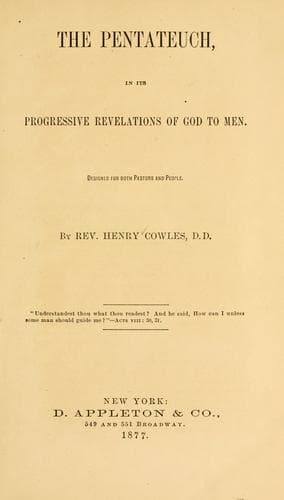
The Pentateuch, in Its Progressive Revelations of God to MenCowles, Henry
Religion
The Pentateuch, in Its Progressive Revelations of God to Men
Cowles, Henry
Bible. Pentateuch -- Criticism, interpretation, etc.
So also of prophecy. It asks for _time_. On the supposition that
the fulfillment is to appear in the Scriptures, an interval of some
duration must come between the utterance and the fulfillment. It was
also wise that prophecy should subserve the superadded purpose of
spiritual comfort to God’s people during the ages between comparative
darkness and forth-breaking light. In fact it gave to God’s people the
first single beams of morning twilight, bearing the grateful assurance
that the Sun of Righteousness would surely rise on the nations in the
fullness of gospel times.
(4.) Still again; by this method of making up inspired history it
is placed side by side with profane history and the most ancient
monuments of the race, and thus invites investigation on the point
of its truthfulness. Is this progressive history of God’s ways toward
men confirmed by whatever reliable history of the same period has come
down to us through other sources? This point well deserves and richly
rewards a careful examination.
(5.) Moreover, it is to be presumed that God would commence his
revelation of himself to our race in the very infancy of their
existence. The Bible shows us that he did. Assuming that at this point
they had every thing to learn, we ought to expect that their first
Bible lessons would turn their thought to the great truths of _natural
religion_――the manifestations of God in his _works of creation and
providence_. In harmony with this reasonable expectation, we read――“In
the beginning God created the heavens and the earth.” In that opening
chapter of revelation, God said, “Let there be light,” and it was;
also “a firmament” above, and it was; “Let the dry land appear,” and it
appeared; “let there be light-bearers in the heavens,” and they shine
forth; let grass and herbs grow; let creatures live in the waters, in
the air, and on the dry land, and it was so; and finally, “let us make
_man_,” far unlike all the rest――“in our own image and likeness”――and
god-like man sprang into being. So onward the narrative witnesses to
the ever-present hand of God in the mists, the rains, and the teeming
vegetation of the new-made world. God, the great Author of nature; God
in nature and evermore over all nature, was the first lesson recorded
in God’s revelation of himself to men.
Public-domain text, read in full here on John Shaqi.
Reviews
Reviews
No reviews yet
Be the first to share your thoughts on this work.
Join the Discussion
Join the discussion
Sign in to leave a comment or review.
Sign InorCreate an account