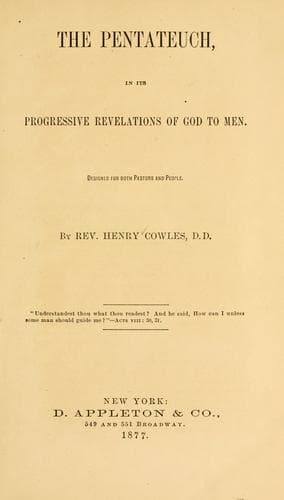
The Pentateuch, in Its Progressive Revelations of God to MenCowles, Henry
Religion
The Pentateuch, in Its Progressive Revelations of God to Men
Cowles, Henry
Bible. Pentateuch -- Criticism, interpretation, etc.
The doctrine of divine providence in regard to the sufferings of good
men――one of the hardest problems of human life――might be expected to
unfold itself gradually. It would be quite too much for the infancy of
human thought and knowledge to grasp this problem and master all its
intricacies. Hence the scope for a gradual unfolding (as we may see)
all the way from the discussions in Job and the Psalms to the clearer
light which shines in the epistle to the Hebrews, as also in Peter and
Paul. This beautiful illustration of progress in divine revelation will
well reward attention in its place.
(6.) On the supposition that God’s scheme for the recovery of our
lost race contemplated some atonement for sin――a provision in its very
nature and relations toward both God and man exceedingly delicate and
critical――it is at least presumable beforehand that God would bring
out this idea _with great care_――with the wisest precaution against
misconception, and not improbably with some foregoing illustrations
of its significance and of its intended application. Precisely this
we see in the great sacrificial system of the Mosaic economy. We only
put essentially the same idea into other and more general terms when
we say that a protracted course of successive revelations provides
for making an antecedent economy pave the way for a subsequent one――a
first revelation preparatory to a second――one set of ideas imprinted
and impressed upon the human mind, made conducive to other and higher
revelations yet to follow. The wisdom of such progressions can not fail
to impress itself upon all thoughtful minds.――――Thus God’s revelations
of himself from age to age were adjusted to the advance in spiritual
development which he had provided for in the human mind. As training
and culture developed higher capacities, new lessons were in order and
higher attainments were made. “Whoso is wise and will observe these
things, even they shall understand” the loving-kindness and matchless
wisdom of the Lord.
Public-domain text, read in full here on John Shaqi.
Reviews
Reviews
No reviews yet
Be the first to share your thoughts on this work.
Join the Discussion
Join the discussion
Sign in to leave a comment or review.
Sign InorCreate an account