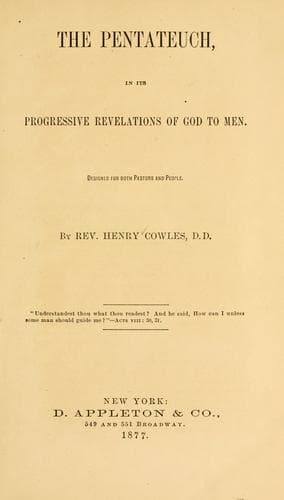
The Pentateuch, in Its Progressive Revelations of God to MenCowles, Henry
Religion
The Pentateuch, in Its Progressive Revelations of God to Men
Cowles, Henry
Bible. Pentateuch -- Criticism, interpretation, etc.
To forestall misapprehensions (possible and sometimes actual), let
it be noted that progress in the revealed science of God by no means
supersedes what has gone before. Naturally it only serves to place old
truths in new and richer light. No one fact affirmed concerning God
in the earlier ages is denied in the later. Certain features of his
character may be brought out more prominently in the later lessons, but
there is no unsaying of the things said before. Nothing can conflict
with this axiom of divine science――“I am the Lord; I change not.”
Prominence may be given in the early ages to such manifestations as
impress men with fear and as set forth God’s righteous justice toward
transgressors; while later revelations may disclose more fully the
depths of divine love and compassion. Yet let none infer that God is
less just in the New Testament than in the Old, or that the earlier
policy of God’s throne has been modified to a larger leniency toward
persistent criminals. The men who flippantly talk of throwing aside the
older revelation “as they do an old almanac” mistake most egregiously.
God has written nothing to be thrown aside. The oldest records still
give us lessons of God shining with unfading freshness and undimmed
glory. The statutes binding on Israel in the wilderness and in Canaan
may not be in the same sense binding on our age, but they have not
for this reason become valueless. They made revelations of God then,
truthful and rich; they make revelations of God still which it were
but small indication of wisdom or good sense to ignore.
CHAPTER I.
CREATION.
FITLY the written word of God to the race begins with the _creation_.
In every reflecting mind the first inquiry must be this: Whence am I?
Whence came my being――this wonderful existence; these active powers?
It must be that I am indebted for all these gifts to some higher Being;
how earnestly then do I ask――_To whom?_――――No other question can claim
priority to this. Every thing in its nature and relations gives it
precedence above all other questions. Inasmuch as my reason affirms
to me that I owe my existence to some great Maker, I feel that I must
know Him and must know my responsibilities to Him. I need to learn also
how the further question――my future destiny――may link itself with my
relations to Him who brought me into being.
Public-domain text, read in full here on John Shaqi.
Reviews
Reviews
No reviews yet
Be the first to share your thoughts on this work.
Join the Discussion
Join the discussion
Sign in to leave a comment or review.
Sign InorCreate an account