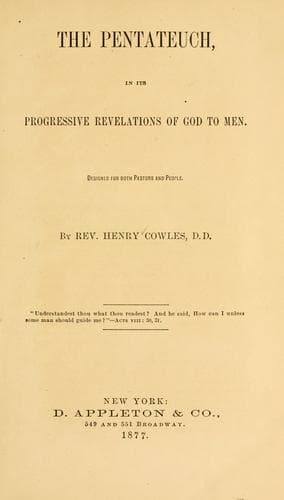
The Pentateuch, in Its Progressive Revelations of God to MenCowles, Henry
Religion
The Pentateuch, in Its Progressive Revelations of God to Men
Cowles, Henry
Bible. Pentateuch -- Criticism, interpretation, etc.
In that great conflict of ages against idolatry, the one final appeal
was wont to be made to this great fact of God’s Creatorship. We have
examples in Ps. 115: 2–8 and Jer. 10: 1–16 and elsewhere.――――Thus
throughout the sacred word this great fact that God is our Creator,
involving the whole sphere of God in nature, stands as the first
witness to his true divinity, the first proof that in him we live
and have our being――the ground of the first claim upon us for
supreme homage, worship, trust, love and obedience. The first lessons
taught in Eden were taken from this great and open volume of natural
religion. The first lessons which God’s people were to place before
the heathen in their mission work of the early ages were drawn from
the visible worlds and from their testimony to the Great Creator. These
manifestations are the alphabet of God; the point therefore from which
progressive revelations begin.
Noticeably the record of the creation (Gen. 1 and 2) rests not with
simply giving the general statement that God made all things, but
enters somewhat into the particulars, reciting in certain points the
_steps of the process and the order of its details_. First the heavens
and the earth had a beginning and this beginning was _from God_. At
some stage in the process, perhaps the next in order after the heavens
and the earth could be said to be, the earth was chaotic, _i. e._
formless and desolate; then God brought forth light; then to clear the
atmosphere somewhat of mists and vapors, he caused some of its waters
to rise into the expanse, and some to descend to the earth below;
then gathered waters below into seas, leaving portions of the earth’s
surface dry land. Then he brought forth grass and herbage; next, the
light-bearers in the heavens appeared――the sun, moon and stars; then
came into being fish, reptiles and fowl; and on the sixth day land,
animals and man. Thus in six successive periods of time, through steps
of gradation easily traced by the witnessing “sons of God” (Job 38: 7),
the processes of this creative work were finished. The Great Father
would have his first-born unfallen “sons” as well as his later-born and
redeemed children enjoy these works of his creative hand, and therefore
he developed them slowly and in the order of naturally successive steps
that they might see that all was truly “good,” “very good.”
Partly because of advances made within recent times in physical
science, partly because of speculations not always friendly in tone to
the inspired record, and partly because of the intrinsic interest and
importance of the subject, some special points in this narrative demand
very particular attention.
1. _The origin of the written record and the manner of its revelation
to men._
Public-domain text, read in full here on John Shaqi.
Reviews
Reviews
No reviews yet
Be the first to share your thoughts on this work.
Join the Discussion
Join the discussion
Sign in to leave a comment or review.
Sign InorCreate an account