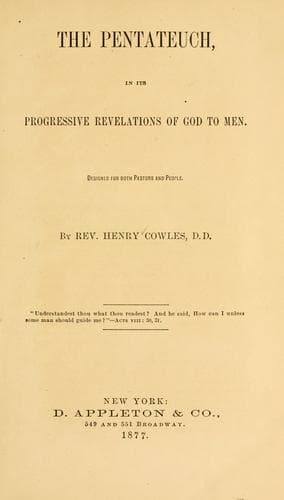
The Pentateuch, in Its Progressive Revelations of God to MenCowles, Henry
Religion
The Pentateuch, in Its Progressive Revelations of God to Men
Cowles, Henry
Bible. Pentateuch -- Criticism, interpretation, etc.
The entire book of Genesis is ascribed to Moses on most valid grounds;
whether as compiler only or as original author, is, therefore, the
first question.――――I do not see how this point can be determined with
absolute certainty. The probabilities in my view favor the supposition
of previously written documents, these probabilities arising, not
to any considerable extent from manifest differences of style in
its various portions, and not at all from diversities in the use
of the names of God, Jehovah and Elohim; but mainly from the strong
presumption that such genealogical records as abound in Genesis,
coupled so largely with numbers, would be put in writing before the
age of Moses. Men who had the knowledge of writing would certainly
appreciate its utility for the preservation of such facts as
these.――――And further; the very use of the word “generations”[1]
(Gen. 2: 4) in the sense of history, and much more still the statement
(Gen. 5: 1), “This is the _book_ of the generations of Adam,” raise
this presumption nearly or quite to a certainty.――――In making up the
historical portions of the Scriptures it seems rational to assume that
the Lord moved “holy men of old” to put in writing such facts falling
under their personal observation and immediate knowledge as he deemed
useful for these sacred records. In some cases the writer might be
(as was Luke) just one remove from the original eye-witnesses, yet
in a position to learn the facts with “perfect understanding” and
“certainty.” We should not doubt the _power_ of God to give to holy
men these historic facts by immediate revelation; but the question is
not one of power, but of wisdom, of divine policy, and of fact. The
divine policy seems to have been (in this case as in miracles) never
to introduce the supernatural, the miraculous, to do what the natural
might accomplish equally well. On this principle inspired men were
moved of God to use their own eyes and minds in writing Scripture
history in all cases when the facts came within their certain knowledge.
There were facts, like these of the creation, which fell under no human
eye, and which therefore do not come under this principle. Some form
of direct revelation from God is, therefore, to be assumed here. Though
the supposition of a revealing angel might find some support from
subsequent prophetic Scriptures, yet a direct revelation from God to
some inspired writer is the more obvious supposition.――――It has been
asked――Was this creation in its processes and announcements shown in a
manner analogous to prophetic vision――the writer then recording in his
own phrase what he saw and heard?――――There being no testimony on this
point from either of the two parties――the divine Revealer or the human
writer――we must leave it undecided. Fortunately it is of no particular
importance to us.――――It is, however, of some importance that we
consider the question whether in this account of the creation we are
Public-domain text, read in full here on John Shaqi.
Reviews
Reviews
No reviews yet
Be the first to share your thoughts on this work.
Join the Discussion
Join the discussion
Sign in to leave a comment or review.
Sign InorCreate an account