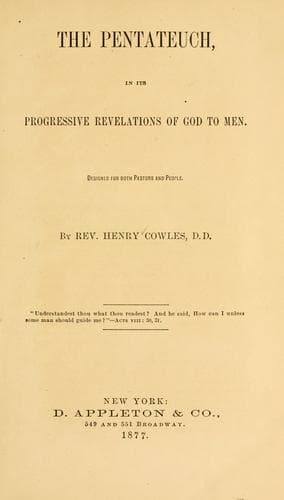
The Pentateuch, in Its Progressive Revelations of God to MenCowles, Henry
Religion
The Pentateuch, in Its Progressive Revelations of God to Men
Cowles, Henry
Bible. Pentateuch -- Criticism, interpretation, etc.
It is unquestionable that the same Hebrew author _does_ use both of
these names for God.――――They made far more account than we of the
various senses of the several names for the Deity. The names Jehovah
and Elohim, were not precisely identical in their suggested ideas,
although both are legitimately used of the one true God. Elohim
suggests that he is the Exalted, Eternal One, the Infinite Creator of
all. This name is therefore specially appropriate in chap. 1. “Jehovah”
conceives of him as the Immutable and ever faithful One, coming into
covenant relation with his people as the Maker and the Fulfiller of
promise. (See remarks on this as God’s memorial name in my Notes on
Hos. 12: 5). Hence as the narrative in Gen. 2 and 3 brings God before
the mind in these special relations to the first human pair and to
the race, this name is here specially appropriate. But lest some
might suppose that this Jehovah is thought of as another God than the
Elohim of chap. 1――the writer uses both names――the Elohim who is also
Jehovah to his rational creature man and especially to all his obedient
trustful people.
(2.) That Gen. 2: 7 relates to the creation of the same first man
as Gen. 1: 26–28, and not of another man ages later, seems to me to
admit of no rational doubt. The inducements to make out two distinct
creations, _i. e._ of two different first men, come from the supposed
proof of the existence of man on the earth ages before the Adam
of antediluvian history. I propose to treat below this question of
_the antiquity of man_. Let it suffice here to say that we must not
mutilate the record or disregard the laws of philology for the sake
of making the sacred narrative conform to theories which are yet
rather assumptions than scientifically proven facts.――――As to the
correspondences and variations in the two narratives of the creation
of man, the first makes prominent his being created in the image of
God: the second assumes this in the fact that God gave him law in Eden;
in the knowledge of the lower animals which his naming them assumes;
in the superior dignity which the Lord’s bringing them before him for
names implies; and in the fact that among them all no helpmeet for
him could be found. His nature ranked far above theirs.――――The earlier
narrative says briefly that God “created them male and female.” The
later one expands this fact much more fully and makes it the foundation
for the law of marriage. The later record treats with the utmost
brevity the main part of the six days’ work and must have been written
with the previous record before the mind, to be a supplementary and
continuative history, designed to bring out prominently the creation of
woman and the scenes of the garden, its moral trial and ultimately its
results.――――The supposition of a different Adam from that of the former
record could never have occurred to the Hebrew mind, and therefore can
not be accepted as the sense of the passage.
Public-domain text, read in full here on John Shaqi.
Reviews
Reviews
No reviews yet
Be the first to share your thoughts on this work.
Join the Discussion
Join the discussion
Sign in to leave a comment or review.
Sign InorCreate an account