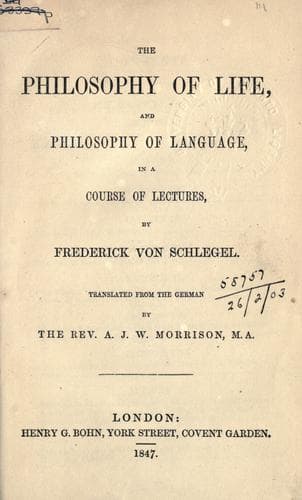
The philosophy of life, and philosophy of language, in a course of lecturesSchlegel, Friedrich von
Philosophy
The philosophy of life, and philosophy of language, in a course of lectures
Schlegel, Friedrich von
Language and languages -- Philosophy; Life; Philosophy
leaf and delicate fiber! In the same way will the ever-growing tree of
human consciousness and life appear in philosophy, whenever it is not
torn from its roots and stripped of its leaves by a pretended wisdom,
but is vividly apprehended by a true science, and exhibited and
presented to the mind in its life and its growth.
Not only, however, the arrangement of the whole, but also the connection
of the several parts of a philosophical treatise or development, is of a
higher kind than any mere mechanical joining, such, for instance, as
that by which two pieces of wood are nailed or glued together. If I must
illustrate this connection by a simile from animated nature, the facts
of magnetism will best serve my purpose. Once magnetically excited, the
iron needle comes into invisible contact and connection with the whole
globe and its opposite poles; and this magnetic clew has guided the bold
circumnavigator into new and unknown regions of the world. Now, the
intrinsic vital coherence of the several thoughts of philosophy
resembles this magnetic attraction; and no such rude, mechanical, and,
in fact, mere external conjunction of thought, like that lately alluded
to, can satisfy the requirements of philosophical connection.
But the supreme intrinsic unity of philosophical thought, or of a
philosophical series of ideas, is quite different from every thing
hitherto mentioned. It belongs not to nature, but to life; it is not
derived from the latter by way of figure or illustration, but is a part
and constituent of it, and goes to the very root and soil of the moral
life. What I mean is, the unity of sentiment--the fixed character,
remaining ever the same and true to itself--the inner necessary sequence
of the thoughts--which, in life no less than in the system and
philosophical theory, invariably makes a great and profound impression
on our minds, and commands our respect, even when it does not carry
along with it our convictions. This, however, is dependent on no form,
and no mere method can attain to it. How often, for instance, in some
famous political harangue, which perhaps the speaker, like the
rhapsodist of old, poured forth on the spur of the moment, do we at once
recognize and admire this character in the thoughts, this consistency of
sentiment? How often, on the contrary, in another composed with the most
exquisite research and strict method, and apparently a far more
elaborate and finished creation of the intellect, we have only to pierce
through the systematic exterior to find that it is nothing but an
ill-connected and chance-medley of conflicting assumptions and opinions
taken from all quarters, and the crude views of the author himself,
devoid of all solidity, and resting on no firm basis, without character,
and wholly destitute of true intrinsic unity?
Public-domain text, read in full here on John Shaqi.
Reviews
Reviews
No reviews yet
Be the first to share your thoughts on this work.
Join the Discussion
Join the discussion
Sign in to leave a comment or review.
Sign InorCreate an account