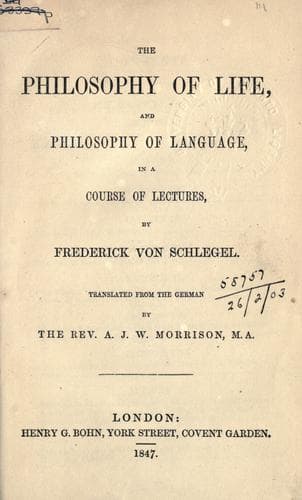
The philosophy of life, and philosophy of language, in a course of lecturesSchlegel, Friedrich von
Philosophy
The philosophy of life, and philosophy of language, in a course of lectures
Schlegel, Friedrich von
Language and languages -- Philosophy; Life; Philosophy
The object, therefore, of philosophy is the inner mental life (_geistige
Leben_), not merely this or that individual faculty in any partial
direction, but man’s spiritual life with all its rich and manifold
energies. With respect to form and method: the philosophy of life sets
out from a single assumption--that of life, or, in other words, of a
consciousness to a certain degree awakened and manifoldly developed by
experience--since it has for its object, and purposes to make known the
entire consciousness, and not merely a single phase of it. Now, such an
end would be hindered rather than promoted by a highly elaborate or
minutely exhaustive form, and a painfully artificial method; and it is
herein that the difference lies between a philosophy of life and the
philosophy of the school. If philosophy be regarded merely as one part
of a general scientific education, then is the instruction in method
(whether under the old traditionary name of Logic or any other) the
chief point to be regarded. For such a mere elementary course, passing
over, or at least postponing for a while the consideration of the
matter, as possessing as yet but a very remote interest for the student,
and, in the default of an adequate internal experience of his own,
incapable of being understood by him, concerns itself rather with the
practice of methodical thought, both as necessary for the future, and as
applicable to all matters. But the preliminary exercise in philosophical
thinking is only the introduction to philosophy, and not philosophy
itself. This school-teaching of philosophy might, perhaps, be rendered
productive of the most excellent consequences, if only it were directed
to the history of the human intellect. What could be more interesting
than a history which should enter into the spirit, and distinctly embody
the various systems which the inventive subtilety of the Greeks gave
birth to, or which, taking a still wider range, should embrace the
science of the Egyptians, and some Asiatic nations, and illustrate the
no less wonderful nor less manifold systems of the Hindoos--those Greeks
of the primeval world? But this, perhaps, would be to encroach upon the
peculiar domain of erudition, and might, moreover, fail to furnish equal
interest for all; and, at any rate, the history of philosophy is not
philosophy itself.
Public-domain text, read in full here on John Shaqi.
Reviews
Reviews
No reviews yet
Be the first to share your thoughts on this work.
Join the Discussion
Join the discussion
Sign in to leave a comment or review.
Sign InorCreate an account