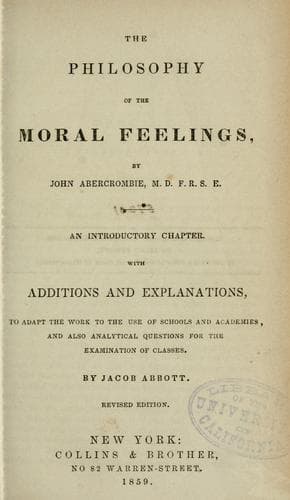
The Philosophy of the Moral FeelingsAbercrombie, John
Religion
The Philosophy of the Moral Feelings
Abercrombie, John
Ethics
part of our mental constitution, on which is founded our conviction of
first truths, and that principle from which is derived our impression of
moral truth:--For the former continues the same in every mind which is
neither obscured by idiocy nor distorted by insanity; but the moral
feelings become vitiated by a process of the mind itself, by which it
has gradually gone astray from rectitude. Hence the difference we find
in the decisions of different men, respecting moral truth, arising from
peculiarities in their own mental condition;--and hence that remarkable
obscuration of mind, at which some men at length arrive, by which the
judgment is entirely perverted respecting the first great principles of
moral purity. When, therefore, we appeal to certain principles in the
mental constitution, as the source of our first impressions of moral
truth, our appeal is made chiefly to a mind which is neither obscured by
depravity, nor bewildered by the refinements of a false philosophy:--it
is made to a mind in which conscience still holds some degree of its
rightful authority, and in which there is a sincere and honest desire to
discover the truth. These two elements of character must go together in
every correct inquiry in moral science; and, to a man in an opposite
condition, we should no more appeal, in regard to the principles of
moral truth, than we should take from the fatuous person or the maniac
our test of those first principles of intellectual truth, which are
allowed to be original elements of belief in every sound mind.
To remedy the evils arising from this diversity and distortion of moral
perception, is one of the objects of divine revelation. By means of it
there is introduced a fixed and uniform standard of moral truth; but, it
is of importance to remark, that, for the authority of this, an appeal
is made to principles in the mind itself, and that every part of it
challenges the assent of the man in whom conscience has not lost its
power in the mental economy.
* * * * *
Keeping in view the distinction which has now been referred to, it would
appear, that there are certain first principles of moral truth, which
arise in the mind by the most simple process of reflection,--either as
constituting its own primary moral convictions, or as following from its
consciousness of these convictions by a plain and obvious chain of
relations. These are chiefly the following.
I. A perception of the nature and quality of actions, as just or
unjust,--right or wrong;--and a conviction of certain duties, as of
justice, veracity, and benevolence, which every man owes to his
fellow-men. Every man, in his own case, again, expects the same offices
from others; and, on this reciprocity of feeling, is founded the
precept, which is felt to be one of universal obligation, to do to
others as we would that they should do to us.
Public-domain text, read in full here on John Shaqi.
Reviews
Reviews
No reviews yet
Be the first to share your thoughts on this work.
Join the Discussion
Join the discussion
Sign in to leave a comment or review.
Sign InorCreate an account