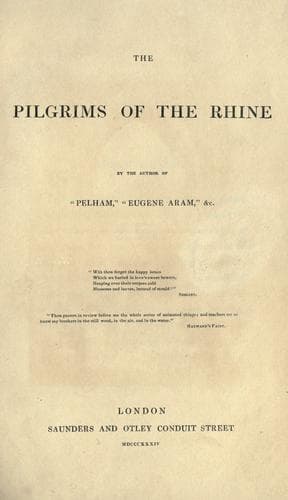
The Pilgrims of the RhineLytton, Edward Bulwer Lytton, Baron
Science
The Pilgrims of the Rhine
Lytton, Edward Bulwer Lytton, Baron
Fairies -- Fiction; Fantasy fiction; Rhine River Valley -- Fiction
The arrangement was made, and St. Amand came now to reside beneath the
same roof as Lucille. And was she not happy that _he_ wanted so constant
an attendance; was she not happy that she was ever of use? St. Amand was
passionately fond of music; he played himself with a skill that was
only surpassed by the exquisite melody of his voice, and was not Lucille
happy when she sat mute and listening to such sounds as in Malines
were never heard before? Was she not happy in gazing on a face to whose
melancholy aspect her voice instantly summoned the smile? Was she not
happy when the music ceased, and St. Amand called “Lucille”? Did not her
own name uttered by that voice seem to her even sweeter than the music?
Was she not happy when they walked out in the still evenings of summer,
and her arm thrilled beneath the light touch of one to whom she was
so necessary? Was she not proud in her happiness, and was there not
something like worship in the gratitude she felt to him for raising her
humble spirit to the luxury of feeling herself beloved?
St. Amand’s parents were French. They had resided in the neighbourhood
of Amiens, where they had inherited a competent property, to which he
had succeeded about two years previous to the date of my story.
He had been blind from the age of three years. “I know not,” said he,
as he related these particulars to Lucille one evening when they were
alone,--“I know not what the earth may be like, or the heaven, or the
rivers whose voice at least I can hear, for I have no recollection
beyond that of a confused but delicious blending of a thousand glorious
colours, a bright and quick sense of joy, A VISIBLE MUSIC. But it is
only since my childhood closed that I have mourned, as I now unceasingly
mourn, for the light of day. My boyhood passed in a quiet cheerfulness;
the least trifle then could please and occupy the vacancies of my mind;
but it was as I took delight in being read to, as I listened to the
vivid descriptions of Poetry, as I glowed at the recital of great deeds,
as I was made acquainted by books with the energy, the action, the heat,
the fervour, the pomp, the enthusiasm of life, that I gradually opened
to the sense of all I was forever denied. I felt that I existed, not
lived; and that, in the midst of the Universal Liberty, I was sentenced
to a prison, from whose blank walls there was no escape. Still, however,
while my parents lived, I had something of consolation; at least I was
not alone. They died, and a sudden and dread solitude, a vast and empty
dreariness, settled upon my dungeon. One old servant only, who had
attended me from my childhood, who had known me in my short privilege of
light, by whose recollections my mind could grope back its way through
the dark and narrow passages of memory to faint glimpses of the sun,
was all that remained to me of human sympathies. It did not suffice,
however, to content me with a home where my father and my mother’s kind
voice were _not_.
Public-domain text, read in full here on John Shaqi.
Reviews
Reviews
No reviews yet
Be the first to share your thoughts on this work.
Join the Discussion
Join the discussion
Sign in to leave a comment or review.
Sign InorCreate an account