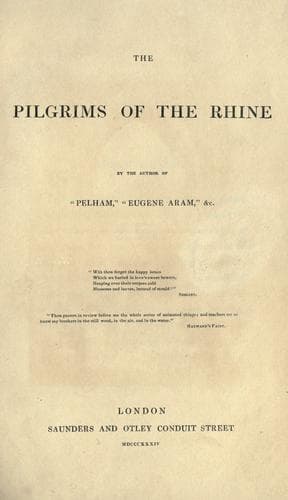
The Pilgrims of the RhineLytton, Edward Bulwer Lytton, Baron
Science
The Pilgrims of the Rhine
Lytton, Edward Bulwer Lytton, Baron
Fairies -- Fiction; Fantasy fiction; Rhine River Valley -- Fiction
A restless impatience, an anxiety to move, possessed
me, and I set out from my home, journeying whither I cared not, so that
at least I could change an air that weighed upon me like a palpable
burden. I took only this old attendant as my companion; he too died
three months since at Bruxelles, worn out with years. Alas! I had
forgotten that he was old, for I saw not his progress to decay; and now,
save my faithless dog, I was utterly alone, till I came hither and found
_thee_.”
Lucille stooped down to caress the dog; she blessed the desertion that
had led him to a friend who never could desert.
But however much, and however gratefully, St. Amand loved Lucille,
her power availed not to chase the melancholy from his brow, and to
reconcile him to his forlorn condition.
“Ah, would that I could see thee! would that I could look upon a face
that my heart vainly endeavours to delineate!”
“If thou couldst,” sighed Lucille, “thou wouldst cease to love me.”
“Impossible!” cried St. Amand, passionately. “However the world may find
thee, _thou_ wouldst become my standard of beauty; and I should judge
not of thee by others, but of others by thee.”
He loved to hear Lucille read to him, and mostly he loved the
descriptions of war, of travel, of wild adventure, and yet they
occasioned him the most pain. Often she paused from the page as she
heard him sigh, and felt that she would even have renounced the bliss of
being loved by him, if she could have restored to him that blessing, the
desire for which haunted him as a spectre.
Lucille’s family were Catholic, and, like most in their station, they
possessed the superstitions, as well as the devotion of the faith.
Sometimes they amused themselves of an evening by the various legends
and imaginary miracles of their calendar; and once, as they were thus
conversing with two or three of their neighbours, “The Tomb of the Three
Kings of Cologne” became the main topic of their wondering recitals.
However strong was the sense of Lucille, she was, as you will readily
conceive, naturally influenced by the belief of those with whom she had
been brought up from her cradle, and she listened to tale after tale
of the miracles wrought at the consecrated tomb, as earnestly and
undoubtingly as the rest.
Public-domain text, read in full here on John Shaqi.
Reviews
Reviews
No reviews yet
Be the first to share your thoughts on this work.
Join the Discussion
Join the discussion
Sign in to leave a comment or review.
Sign InorCreate an account