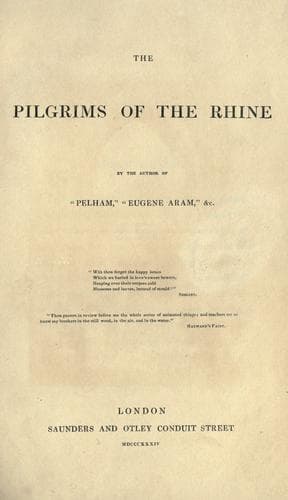
The Pilgrims of the RhineLytton, Edward Bulwer Lytton, Baron
Science
The Pilgrims of the Rhine
Lytton, Edward Bulwer Lytton, Baron
Fairies -- Fiction; Fantasy fiction; Rhine River Valley -- Fiction
And the Kings of the East were no ordinary saints; to the relics of
the Three Magi, who followed the Star of Bethlehem, and were the first
potentates of the earth who adored its Saviour, well might the pious
Catholic suppose that a peculiar power and a healing sanctity would
belong. Each of the circle (St. Amand, who had been more than usually
silent, and even gloomy during the day, had retired to his own
apartment, for there were some moments when, in the sadness of his
thoughts, he sought that solitude which he so impatiently fled from at
others)--each of the circle had some story to relate equally veracious
and indisputable, of an infirmity cured, or a prayer accorded, or a sin
atoned for at the foot of the holy tomb. One story peculiarly affected
Lucille; the narrator, a venerable old man with gray locks, solemnly
declared himself a witness of its truth.
A woman at Anvers had given birth to a son, the offspring of an illicit
connection, who came into the world deaf and dumb. The unfortunate
mother believed the calamity a punishment for her own sin. “Ah, would,”
said she, “that the affliction had fallen only upon me! Wretch that I
am, my innocent child is punished for my offence!” This, idea haunted
her night and day; she pined and could not be comforted. As the child
grew up, and wound himself more and more round her heart, his caresses
added new pangs to her remorse; and at length (continued the narrator)
hearing perpetually of the holy fame of the Tomb of Cologne, she
resolved upon a pilgrimage barefoot to the shrine. “God is merciful,”
said she; “and He who called Magdalene his sister may take the mother’s
curse from the child.” She then went to Cologne; she poured her tears,
her penitence, and her prayers at the sacred tomb. When she returned to
her native town, what was her dismay as she approached her cottage to
behold it a heap of ruins! Its blackened rafters and yawning casements
betokened the ravages of fire. The poor woman sank upon the ground
utterly overpowered. Had her son perished? At that moment she heard
the cry of a child’s voice, and, lo! her child rushed to her arms, and
called her “mother!”
He had been saved from the fire, which had broken out seven days before;
but in the terror he had suffered, the string that tied his tongue had
been loosened; he had uttered articulate sounds of distress; the curse
was removed, and one word at least the kind neighbours had already
taught him to welcome his mother’s return. What cared she now that
her substance was gone, that her roof was ashes? She bowed in grateful
submission to so mild a stroke; her prayer had been heard, and the sin
of the mother was visited no longer on the child.
Public-domain text, read in full here on John Shaqi.
Reviews
Reviews
No reviews yet
Be the first to share your thoughts on this work.
Join the Discussion
Join the discussion
Sign in to leave a comment or review.
Sign InorCreate an account