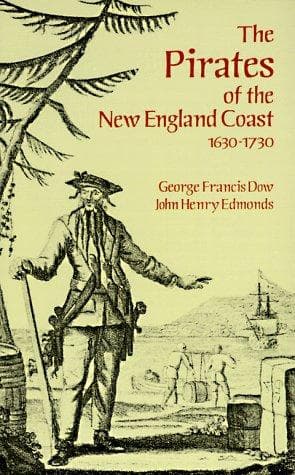
The pirates of the New England coast, 1630-1730 — John Shaqi
The pirates of the New England coast, 1630-1730Dow, George Francis
History
The pirates of the New England coast, 1630-1730
Dow, George Francis
New England -- History -- Colonial period, ca. 1600-1775; Pirates -- New England -- History
The success of the buccaneers before long paralyzed Spanish commerce
and fewer ships were sent to the American colonies so that the
“Brethren,” then numbering several thousands, began to plan attacks
upon land. The first Spanish settlement assaulted was Campeachy, on
the coast of Yucatan. An Englishman named Lewis Scot led this attack
which resulted in much loot and the almost entire destruction of the
city. Another Englishman named Davis took Nicaragua and plundered
the churches of vast quantities of plate and jewels. L’Olonnais, a
Frenchman, with eight vessels filled with men, fell upon Maracaibo and
after much hard fighting brought away 260,000 pieces of eight and a
great amount of jewels and plate. “But,” writes Esquemeling, “in three
weeks they had scarce any money left, having spent it all in things of
little value, or lost it at play. The taverns and stews, according to
the custom of the pirates, got the greatest part.”
Capt. Henry Morgan, the leader of the expedition against Panama,
achieved the greatest fame among all these lawless chieftains. Charles
II knighted him and made him governor of Jamaica, where he turned upon
his late companions and waged a bitter warfare. An early exploit of
Morgan was the taking of Puerto Velo, one of the strongest fortresses
in New Spain. Surprising the sentry at night he easily captured the
outer defences. The prisoners were placed in a room with several
barrels of gunpowder and as they were blown into the air the buccaneers
assaulted the citadel. The cloisters had been seized and the priests
and nuns were forced to climb the scaling ladders before the men, “the
religious men and women ceasing not to cry to the governor and beg him
to deliver the castle, and so save both his and their lives,” writes
Esquemeling. The castle surrendered at last, though “with great loss of
the said religious people.” The loot amounted to over 250,000 pieces
of eight and much other spoil which was soon squandered at Port Royal,
a pirate town in Jamaica that supplied almost unlimited resources for
debauchery.
[Illustration: SIR HENRY MORGAN, THE BUCCANEER, BEFORE PANAMA
From an engraving in Johnson’s “General History of the Lives and
Adventures of the Most Famous Highwaymen, Murderers, Pyrates,” etc.,
London, 1734, in the Harry Elkins Widener Collection, Harvard College
Library]
Public-domain text, read in full here on John Shaqi.
Reviews
Reviews
No reviews yet
Be the first to share your thoughts on this work.
Join the Discussion
Join the discussion
Sign in to leave a comment or review.
Sign InorCreate an account