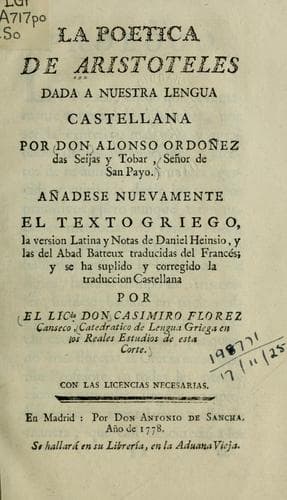
Aesthetics -- Early works to 1800; Poetry -- Early works to 1800
Reversal of the Situation is a change by which the action veers round
to its opposite, subject always to our rule of probability or necessity.
Thus in the Oedipus, the messenger comes to cheer Oedipus and free
him from his alarms about his mother, but by revealing who he is, he
produces the opposite effect. Again in the Lynceus, Lynceus is being led
away to his death, and Danaus goes with him, meaning, to slay him; but
the outcome of the preceding incidents is that Danaus is killed and
Lynceus saved. Recognition, as the name indicates, is a change from
ignorance to knowledge, producing love or hate between the persons
destined by the poet for good or bad fortune. The best form of
recognition is coincident with a Reversal of the Situation, as in the
Oedipus. There are indeed other forms. Even inanimate things of the most
trivial kind may in a sense be objects of recognition. Again, we may
recognise or discover whether a person has done a thing or not. But the
recognition which is most intimately connected with the plot and action
is, as we have said, the recognition of persons. This recognition,
combined, with Reversal, will produce either pity or fear; and actions
producing these effects are those which, by our definition, Tragedy
represents. Moreover, it is upon such situations that the issues of good
or bad fortune will depend. Recognition, then, being between persons,
it may happen that one person only is recognised by the other-when the
latter is already known--or it may be necessary that the recognition
should be on both sides. Thus Iphigenia is revealed to Orestes by the
sending of the letter; but another act of recognition is required to
make Orestes known to Iphigenia.
Two parts, then, of the Plot--Reversal of the Situation and
Recognition--turn upon surprises. A third part is the Scene of
Suffering. The Scene of Suffering is a destructive or painful action,
such as death on the stage, bodily agony, wounds and the like.
XII
[The parts of Tragedy which must be treated as elements of the whole
have been already mentioned. We now come to the quantitative parts,
and the separate parts into which Tragedy is divided, namely, Prologue,
Episode, Exode, Choric song; this last being divided into Parode and
Stasimon. These are common to all plays: peculiar to some are the songs
of actors from the stage and the Commoi.
Public-domain text, read in full here on John Shaqi.
Reviews
Reviews
No reviews yet
Be the first to share your thoughts on this work.
Join the Discussion
Join the discussion
Sign in to leave a comment or review.
Sign InorCreate an account