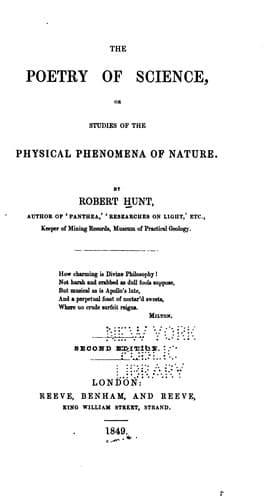
The Poetry of Science; or, Studies of the Physical Phenomena of Nature — John Shaqi
The Poetry of Science; or, Studies of the Physical Phenomena of NatureHunt, Robert
Philosophy
The Poetry of Science; or, Studies of the Physical Phenomena of Nature
Hunt, Robert
Physics; Science
Boscovich regarded the constitution of matter differently. The ultimate
atom was with him a point surrounded by powers of infinite elasticity.
(See _Dr. Robisons Mechanical Philosophy_, for a full explanation of
the theory of Boscovich.)
The view entertained by Dr. Faraday, which will be comprehended from
one or two short extracts from his valuable and suggestive paper,
claims attention:--
“If the view of the constitution of matter already referred to be
assumed to be correct--and I may be allowed to speak of the particles
of matter, and the space between them (in water, or in the vapour
of water, for instance), as two different things--the space must be
taken as the only continuous part, for the particles are considered
as separated by space from each other. Space will permeate all masses
of matter in every direction like a net, except that in the place of
meshes it will form cells, isolating each atom from its neighbours, and
itself only being continuous.”
Examining the question of the conducting power of different bodies,
and observing that as space is the only continuous part, so space,
according to the received view of matter, must be at one time a
conductor, at others a non-conductor, it is remarked:
“It would seem, therefore, that, in accepting the ordinary atomic
theory, space may be proved to be a non-conductor in non-conducting
bodies, and a conductor in conducting bodies; but the reasoning ends
in this--a subversion of that theory altogether; for, if space be
an insulator, it cannot exist in conducting bodies; and if it be a
conductor, it cannot exist in insulating bodies.”--_A Speculation
touching Electric Conduction, and the Nature of Matter_: by Michael
Faraday, D.C.L., F.R.S., &c.: Philosophical Magazine, vol. xxiv. Third
Series.
See also Wollaston, _On the Finite Extent of the Atmosphere_.--Phil.
Trans. 1822. Young, _On the Essential Properties of Matter_.--Lectures
on Natural Philosophy. Mossotti, _On Molecular Action_.--Scientific
Memoirs, vol. i. p. 448.
CHAPTER II.
MOTION.
Are the Physical Forces modes of Motion?--Motion
defined--Philosophical Views of Motion, and the Principles to
which it has been referred--Motions of the Earth and of the Solar
System--Visible Proofs of the Earth’s Motion on its Axis--Influence
of the proper Motions of the Earth on the Conditions of
Matter--Theory of the Conversion of Motion into Heat, &c.--The
Physical Forces regarded as principles independent of Motion,
although the Cause and often apparently the Effects of it.
Many of the most eminent thinkers of the present time are disposed to
regard all the active principles of nature as “modes of motion,”--to
look upon light, heat, electricity, and even vital force, as phenomena
resulting from “change of place” among the particles of matter; this
change, disturbance, or motion, being dependent upon some undefined
mover.[2]
Public-domain text, read in full here on John Shaqi.
Reviews
Reviews
No reviews yet
Be the first to share your thoughts on this work.
Join the Discussion
Join the discussion
Sign in to leave a comment or review.
Sign InorCreate an account