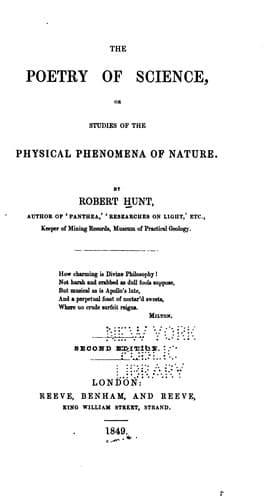
The Poetry of Science; or, Studies of the Physical Phenomena of NatureHunt, Robert
Philosophy
The Poetry of Science; or, Studies of the Physical Phenomena of Nature
Hunt, Robert
Physics; Science
The habit of leaving purely inductive examination for the delusive
charms of hypothesis--of viewing the material world as a metaphysical
bundle of essential properties, and nothing more--has led some eminent
philosophers to struggle with the task of proving that all the
wonderful manifestations of the great physical powers of the universe
are but modifications of motion, without the evidence of any antecedent
force.[3]
The views of metaphysicians regarding motion involve many subtle
considerations which need not at present detain us. We can only
consider motion as a change of place in a given mass of matter. Now
matter cannot effect this of itself, no change of place being possible
without a mover; and, consequently, motion cannot be a _property_ of
matter, in the strict sense in which that term should be accepted.[4]
Motion depends upon certain external disturbing and directing forces
acting upon all matter; and, consequently, as every mode of action
is determined by some excitement external to the body moved, motion
cannot, philosophically, be regarded otherwise than as a peculiar
affection of matter under determinable conditions. “We find,” says Sir
Isaac Newton, “but little motion in the world, except what plainly
flows from either the active principles of nature, or from the command
of the willer.”[5]
Plato, Aristotle, and the Pythagoreans, supposed that throughout all
nature an active principle was diffused, upon which depended all the
properties exhibited by matter. This is the same as the “plastic
nature” of Cudworth,[6] the “intellectual and artificial fire” of
Bishop Berkeley;[7] and to these all modes of motion were referred.
Sir Isaac Newton also regards the material universe and its phenomena
as dependent upon “_active principles_”--for instance, the cause of
gravity--whereby the planets and comets preserve their motions in their
orbits, and all bodies acquire a degree of motion in falling; and the
cause of fomentation--whereby the heart and blood of animals preserve
a perpetual warmth and motion--the inner parts of the earth are kept
constantly warmed--many bodies burn and shine--and the sun himself
burns and shines, and with his light warms and cheers all things.
Public-domain text, read in full here on John Shaqi.
Reviews
Reviews
No reviews yet
Be the first to share your thoughts on this work.
Join the Discussion
Join the discussion
Sign in to leave a comment or review.
Sign InorCreate an account