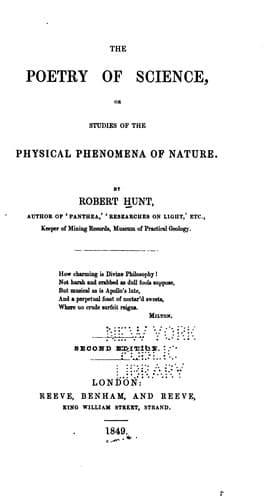
The Poetry of Science; or, Studies of the Physical Phenomena of NatureHunt, Robert
Philosophy
The Poetry of Science; or, Studies of the Physical Phenomena of Nature
Hunt, Robert
Physics; Science
The earth turns on its axis at the rate of more than 1,000 miles an
hour, and passes around the sun with the speed of upwards of 68,000
miles in the same time.[8] The earth and the other planets of our
system move in ellipses around a common centre: therefore their motion
cannot have been originally communicated merely by the impressed force
of projection. Two forces, at least, must have operated, one making
the planets tend directly to the centre, and the other impelling them
to fly off at a tangent to the curve described. Here we have a system
of spheres, held by some power to a great central mass, around which
they revolve with a fearful velocity. Nor is this all; the Solar System
itself, bound by the same mystic chain to an undiscovered centre, moves
towards a point in space at the rate of 33,550,000 geographical miles,
whilst our earth performs one revolution around the sun.[9]
The evidence of the motion of the Earth around its axis, as afforded
by the swinging of a pendulum or the rotation of a sphere, is too
interesting to be omitted. In mechanical philosophy, we have two
terms of the same general meaning--the conservation of the plane
of vibration--and the conservation of the axis of rotation. For
the non-scientific reader, these terms require explanation, and in
endeavouring to simplify this as much as possible, we must ask the
indulgence of the Mechanical Philosopher. Let us fix in the centre
of a small round table an upright rod, having an arm extending from
its top, to which we can suspend a tolerably heavy weight attached
to a string. This is our piece of apparatus: upon the table draw a
chalk line, along which line we intend our pendulum to swing, and
continuing this line upon the floor, or by a mark on the wall, our
arrangements are complete. Raise steadily the bob of our pendulum,
and set it free, so that its plane of vibration is along the line
which has been marked. As the pendulum is swinging firmly along this
line, slowly and steadily turn the table round. It will then be seen
that the pendulum will still vibrate in the direction of the line we
have continued onward to the wall, but that the line on the table is
gradually withdrawn from it. If we had no upright, we might turn the
table entirely round, without in the slightest degree altering the
line along which the pendulum performs its oscillations. Now, if from
some elevated spot, say, from the centre of the dome of St. Paul’s,
a long and heavy pendulum is suspended, and if on the floor we mark
the line along which we set the pendulum free to vibrate, it will be
seen, as in the experiment with the table, that the marked line moves
away from under the pendulum. It continues to vibrate in the plane it
first described, although the line on the earth’s surface continues
to move forward by the diurnal rotation around the axis. Similar to
this is the law of the conservation of the axis of rotation. If a
common humming-top, the spindle of which is its axis of rotation, is
Public-domain text, read in full here on John Shaqi.
Reviews
Reviews
No reviews yet
Be the first to share your thoughts on this work.
Join the Discussion
Join the discussion
Sign in to leave a comment or review.
Sign InorCreate an account